Connected safety is not a promise that devices remove risk. It is a disciplined way to capture status, alarm, inspection, and training data early enough for supervisors to act.
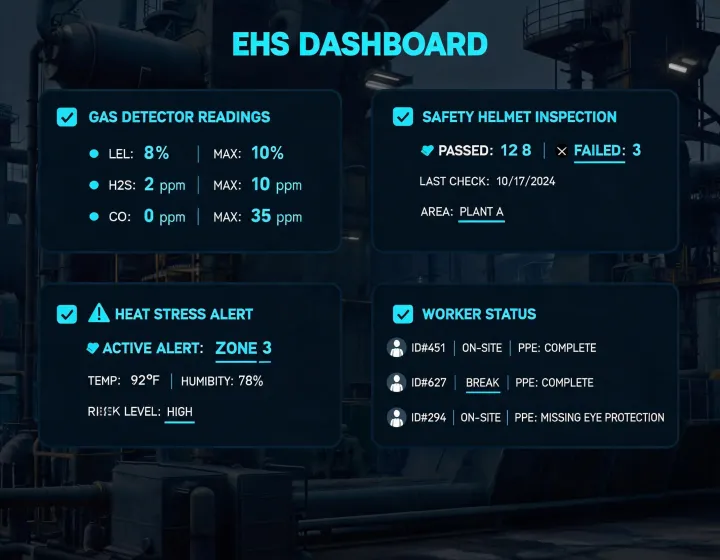
Portable gas detector workflows can record LEL, O2, CO, and H2S readings, calibration status, bump-test notes, and alarm acknowledgment. Intrinsic-safety records should be verified for the exact hardware configuration.
NFC or QR-linked helmet records can track issue date, worker assignment, accessory stack, inspection status, and retirement trigger for ANSI Z89.1-based programs.
Wearable heat-stress bands can support trend review for high-temperature work, provided the customer defines escalation thresholds and supervisor responsibilities.
Harness tags can connect inspection due dates, withdrawal status, and assigned worker or jobsite records without replacing competent-person inspection.
The demo view groups alerts by worksite, crew, device type, and required follow-up. It is meant for pilot planning, not for making absolute safety claims. Customers decide which events require immediate escalation, which support training review, and which belong in a monthly audit packet.
The pilot starts by choosing one or two integration destinations. API and webhook design should follow the customer's data retention policy, privacy requirements, and incident escalation procedure.
The calculator model asks for worker count, current inspection hours, alarm review time, and the cost of missed documentation. It returns a planning estimate, not a guaranteed savings claim.
Define worker groups, devices, data fields, escalation owners, and success metrics.
Deploy devices, train supervisors, verify data flow, and capture early issues.
Review alert patterns, inspection compliance, and training gaps by site or shift.
Prepare rollout recommendation, distributor package, and documentation checklist.
Share the devices, site count, and reporting tools you want to connect. We will outline a pilot sequence and integration questions.