The Tuesday Morning That Reset Our Whole PPE Strategy
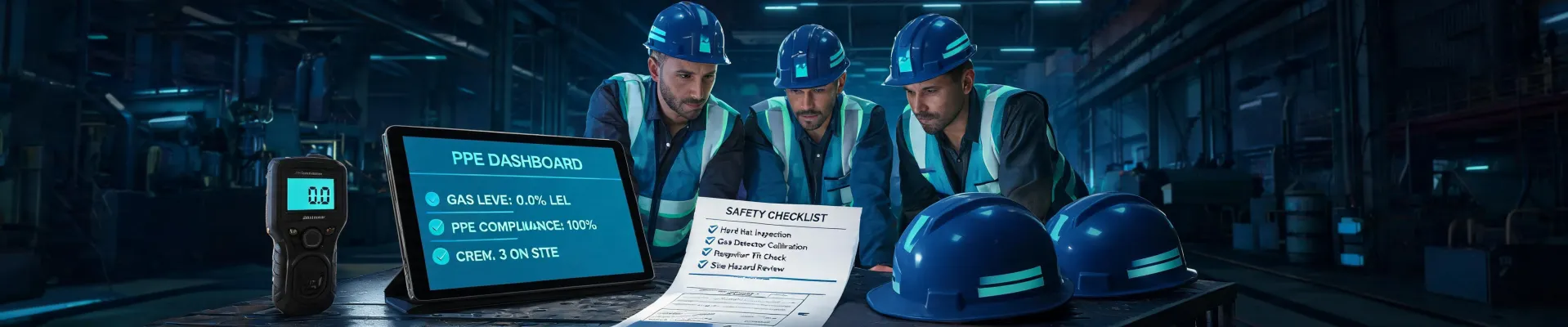
The call came in at 7:40 on a Tuesday morning in August 2024. Small solvent spill on the manufacturing floor. The technician was fine—a minor splash on his forearm that the on-site first-aid lead cleaned up in about five minutes. But our safety director didn't see it that way.
She saw a warning light.
By Friday, I had a new assignment tacked onto my regular job description: consolidate PPE purchasing across all three of our company sites. One manufacturing floor (roughly 320 people), one outdoor training site we share with a law enforcement partner, and the corporate campus that somehow—don't ask—includes a pool.
Before that week, each site bought its own safety supplies. Office manager here. Facilities lead there. A retired logistics guy handling the training site. Three approaches, three sets of invoices, and somewhere north of $46,000 a year in combined PPE spend that nobody was actually looking at.
My job was to standardize. Cut waste. Make sure the next splash didn't turn into something with a lawyer attached.
What I actually did, in the first three months, was create about $2,400 of waste. Then I fixed it. And the fix taught me more about procurement than the previous five years of office administration combined.
"Which PPE Can Protect You From Liquid Chemicals?"
That's the question my safety director asked me on day one. I didn't have a good answer. I had a bad one: "the stuff we already have?"
Turns out the manufacturing floor had technicians handling solvents in garden gloves. Not chemical-resistant nitrile. Garden gloves. Green thumbs, yellow cuffs, barcode on the tag.
The thinking came from an old floor manager who retired in 2021. His logic was simple: any glove is better than no glove.
That was true 30 years ago when the alternatives were leather work gloves or literally nothing. Today, it's flat wrong. Some glove materials break down on contact with solvents faster than bare skin does—they trap the chemical against your hand instead of blocking it.
I had to source chemical-resistant nitrile, laminate, and butyl gloves matched to the SDS sheets for each chemical on the floor. That meant three glove types rather than one, plus a reference poster taped to the chemical storage cabinet so nobody had to guess at 6 a.m.
The sticker price on the right gloves was roughly 4x the garden gloves. The total cost, of course, was way lower—because the garden gloves cost us a near-miss, a compliance finding, and about six hours of my life I'm not getting back.
The "Cheap" Earmuffs That Cost $2,400
The hearing protection story is where things got expensive. Our manufacturing floor runs between 92 and 95 dBA—over the OSHA action level for 8-hour exposure, so hearing protection there is mandatory, not optional.
I went to Amazon first. Not proud of it. But I did.
Found a pair of "safety earmuffs" for $18 a unit. High rating, quick ship, looked fine in the photos. I thought—great, I'll order 60 pairs and be done.
If I'd read the reviews first, I would've caught the pattern. Too small for adult head. Doesn't seal well. Workers won't wear them. The ratings looked good because most of the reviews came from hobbyists and home users—not people wearing them 8 hours a day on a factory floor.
That's a classic review-reading mistake, by the way. Reviews from the wrong use case can look great and still be useless to you. Learned that one the hard way.
Three months later, our safety lead pulled the numbers. Ear protection compliance on the floor had dropped from 89% to 61%. Workers were pulling the muffs off mid-shift and stuffing them in lockers. The pads cracked. The folding mechanism broke on 14 units.
We were looking at a replacement order, a compliance write-up, and about $2,400 in wasted spend on the first batch.
What followed was a communication failure I'm still not proud of. I told the vendor "we need better noise reduction." They told me "our units are rated NRR 25, that's compliant." Both true statements. But what I wanted was attenuation that actually worked on a 95 dBA floor for 8-hour shifts—not just a number on a spec sheet that satisfied the minimum. We were using the same words and meaning different things.
I discovered the gap when the safety lead sat down with the replacement earmuffs I'd sent her and said: "These don't fit under the hard hats, and the cushion isn't sealing against the temple."
The Peltor Switch
We went back to the drawing board—this time with a checklist, not a search bar.
For the manufacturing floor, we ended up on the 3M Peltor Optime 105 (model H10A). NRR 30. I read through 3M Peltor H10A Optime 105 earmuffs reviews, cross-checked the attenuation data against NIOSH guidance, and compared the headband adjustment range against the fit complaints from the first batch. Heavier than what we had, but workers actually wore them—which is the whole game. The cushions seal properly, the band widens enough for adult head sizes, and the attenuation holds up across a full 8-hour shift.
For the training site, the law enforcement partner needed something tuned for impulsive noise—gunfire, not continuous machine noise. That's a completely different problem. Continuous noise and impulse noise have different frequency profiles, and the earmuff that wins on one isn't automatically the best on the other. We ended up going with the 3M Peltor Sport Tactical 100 for that site after reading through a Peltor Sport Tactical 100 review and confirming the impulse-noise profile matched range use. A colleague who shoots recreationally on weekends suggested Eargasm earplugs as a more discreet alternative for the range side. They're well-regarded in the consumer space—comfortable, good sound quality, popular for concerts and personal range days. But they aren't an OSHA-compliant substitute for a full workplace hearing conservation program, so they stayed off the work order and went on the personal-gear suggestion list instead.
One more piece of the consolidation, which I'll keep short: the campus pool needed a code-compliant safety barrier, and I ended up sourcing a glass pool fence. Completely unrelated to PPE, except it taught the same lesson. The unit cost on the glass panels quoted by the first vendor looked fine. The all-in installed cost—with anchors, deck mounting, engineering certification, and inspection coordination—came in around 2.5x higher. The vendor with the cheapest panel price wasn't the cheapest job. A second vendor quoted a higher panel price with installation bundled in, and that quote beat the "cheap" one by several thousand dollars once everything was included.
Same story, different product. The sticker price is not the price.
The Framework I Use Now
I calculate total cost of ownership before comparing any vendor quote. For PPE and safety gear, that means:
What goes into a PPE total-cost calculation
- Sticker price × quantity needed per year.
- Replacement cost — how often does the unit actually get replaced? The $18 earmuff in my story was replaced three times in 12 months. The Peltor lasted the year with one cushion swap.
- Compliance cost — every non-compliant purchase is a hidden liability. The garden gloves were "cheaper" until they almost cost us a fine.
- Labor time — my hours hunting down the fix are a real cost, just one that doesn't show up on an invoice.
- Downtime and rework — every replacement order is time your floor isn't fully equipped and your safety lead isn't doing safety work.
I also built a small approval checklist—maybe the only formal process I've ever pushed through in this role. Every safety purchase above $500 gets an SDS check (where applicable), a use-case match (who's wearing it, for how long, under what conditions), and a total-cost calc that includes a 12-month replacement estimate. Not glamorous. It has already saved us twice.
The FTC's truth-in-advertising guidance (ftc.gov) is a good reminder that "safety rated" and "OSHA compliant" aren't synonyms—they're both claims a vendor should be able to substantiate in writing. Ask for the paperwork. If the vendor hesitates, that's your answer.
In hindsight, I should have pushed back on the timeline when the safety review landed on my desk in the middle of a Q3 crunch. But with an inspection date on the calendar and my VP asking for updates every Monday, I made the call with incomplete information. That's the reality of admin procurement—you rarely get to be thorough. So you build the checklist for the next time you're in a hurry.
What I'd Tell the Next Admin Buyer
If you've ever bought safety gear by price alone—and honestly, most of us have—you know that sinking feeling when the cheap order turns into a redo. I've been there. Trust me on this one.
The $2,400 wasn't really about money. It was about time I didn't get back, credibility I had to rebuild with the safety team, and the realization that the garden gloves, the Amazon earmuffs, and the glass pool fence quote all had the same shape. A low number at the front, a much bigger number at the end.
The fix isn't fancier math. It's slower math, done before you place the order. Ask what happens in month three. Ask who's actually wearing the thing for 8 hours. Ask what it costs to replace, re-inspect, or reorder when the first try doesn't work.
Take it from someone who learned it the way you learn most things in office administration: by eating the redo.

Idris Adebayo
Idris Adebayo is an eye, face, and hearing protection analyst specializing in safety glasses, chemical splash goggles, face shields, welding helmets, laser eyewear, earplugs, and earmuffs. He references ANSI Z87.1, EN 166, and EN 352 while examining optical class, impact rating, shade number, splash coverage, anti-fog performance, attenuation by frequency, NRR, seal pressure, fit, and compatibility with other PPE. His evaluations help industrial hygienists, fabrication shops, laboratories, and procurement teams control impact, radiation, chemical splash, and occupational noise exposures without undermining comfort or communication.