It was 9:37 on a Saturday night when Bryan called. I was about three bites into a pepperoni pizza, and the only reason I remember the exact time is because I thought, “Nobody calls at 9:37 with good news.”
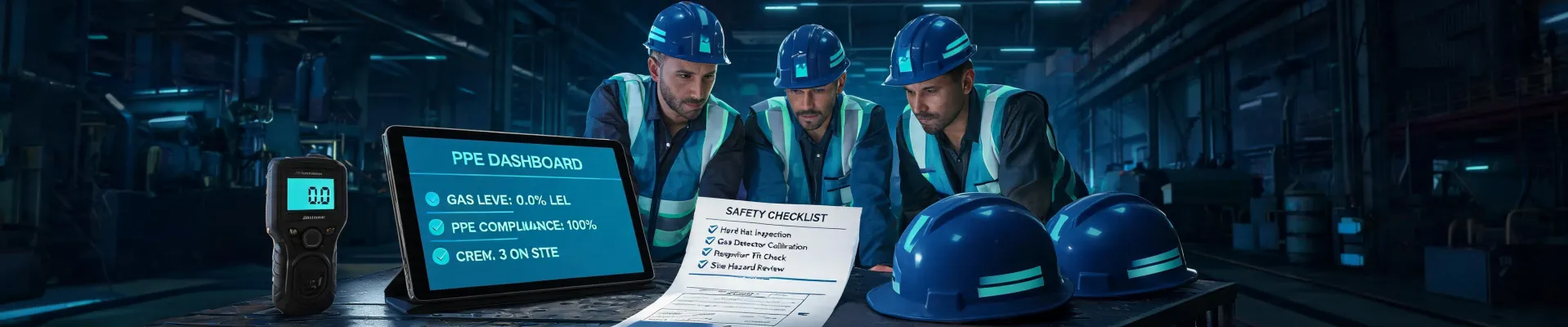
Bryan runs safety for a mid-size construction firm. He’s one of those guys who’s weirdly cheerful even when things are falling apart. But that night, his voice was flat. “I’ve got a problem. OSHA’s showing up at 7 a.m. Monday, and I just found 20 cracked hard hats in the storage shed.”
I’ve been coordinating emergency orders for a safety equipment distributor for six years, and I’ve handled somewhere around 200 rush jobs. I know the drill. “Do you need replacements?” I asked. “Yes,” he said. “At least 40 MSA safety hard hats.”
We carry MSA because they’ve been making head protection for decades. The MSA V-Gard is the workhorse on a thousand job sites. But the brand isn’t the point — shell integrity is. A cracked hard hat isn’t a cosmetics problem. It can fail on impact. And an inspector knows exactly where to look.
We had 40 MSA V-Gard hard hats in stock. Problem was, our delivery truck had left at 3 p.m. The only way to get them there in time was overnight freight, and that meant a $420 rush fee on top of the cost of the hats.
Bryan went quiet. “My boss is going to flip. We have a standard-shipping-only policy.”
I understood the hesitation. To be fair, $420 is nothing to shake a stick at. But I’d done this math before. “What’s the downside if the inspection fails?” I asked.
“They’ll shut the site down until we fix it. At least a day of lost work. That’s about $15,000. Plus a fine. Maybe $50,000 if they want to make an example.”
“So tell your boss the $420 buys you certainty. Not just speed. Certainty.” That’s what a rush fee really buys. From the outside, people assume it just means the vendor works faster. The reality is that guaranteed delivery uses a completely different workflow — dedicated slots on freight shipments, direct lines to warehouse staff, and backups for the backups. It’s not the same as paying someone to “try hard.”
Here’s something vendors won’t tell you: when we say “in stock,” it might mean a specific distribution center, not necessarily the one near you. We called three warehouses to find 40 hats that could leave our dock that night. The difference between “we have it” and “we can get it” is exactly the difference between a standard quote and a rush quote.
While I was on hold with the freight company, Bryan let out a long breath. “This has been the worst Saturday ever,” he said. “My smoke detector decided to start beeping at 3 a.m. It chirps every 40 seconds. I already replaced the 9V battery for smoke detector, and it’s still doing it.”
That one I know cold. Here’s the trick: take the old battery out, press and hold the test button for 15 seconds to drain any leftover charge, then put a fresh 9V battery in. That resets the sensor and stops the low-battery chirp. I told him to try that when he got home.
He actually chuckled. “If you can fix that, I’m hiring you to pick my wood fence styles, too. My wife just texted me four different options and expects a decision by tomorrow.”
“That one’s easy,” I said. “Go with the shadowbox style — it’s more secure, looks good from both sides, and does better in wind. A lot of people go with the dog-ear for the lower price, but if you’re paying for a fence, you want it to stay standing. Same with hard hats: pick for the environment, not the budget.”
He laughed. “Are you a fence consultant now?”
“Nah. Just fifteen years of seeing cheap equipment fail in exactly the wrong moment.”
The freight confirmation came through. The hats would arrive by 6:50 a.m. Monday. I sent Bryan the details and the invoice. He emailed his boss, then called me back. “Approved. Send it.”
The hats arrived at 6:52 a.m. Bryan texted me a photo of the pallet next to a scrawny palm tree. “You’re a lifesaver,” he wrote. The inspection passed. No violations. No shutdown. His company kept that contract and later landed a second one worth $150,000. Bryan’s boss sent a note thanking us for the “extraordinary effort.” In truth, it was just a guaranteed delivery commitment.
So here’s the thing I keep telling clients: the cheap option is only cheap if it’s reliable. When it’s not, it’s an expensive gamble. I’m not saying you should always pay for rush. I’m saying you should pay for certainty when the downside is big.
As of January 2025, USPS lists the price of a first-class stamp at 73 cents. That’s fine for a letter you don’t mind waiting for. But if you need a package to land by sunrise, a stamp won’t do it. You pay for guaranteed delivery because it comes with a promise — and because that promise is backed by processes, not hope. That’s also why the FTC requires companies to substantiate delivery claims. A vendor saying “probably tomorrow morning” isn’t a commitment. Get the one that says “by 6:50 a.m.”
By the way, Bryan fixed his smoke detector that night. He texted me at 11:12 p.m.: “No more beeping. I’m a hero.” He also went with the shadowbox fence. Good call.

Jane Smith
I’m Jane Smith, a senior content writer with over 15 years of experience in the packaging and printing industry. I specialize in writing about the latest trends, technologies, and best practices in packaging design, sustainability, and printing techniques. My goal is to help businesses understand complex printing processes and design solutions that enhance both product packaging and brand visibility.