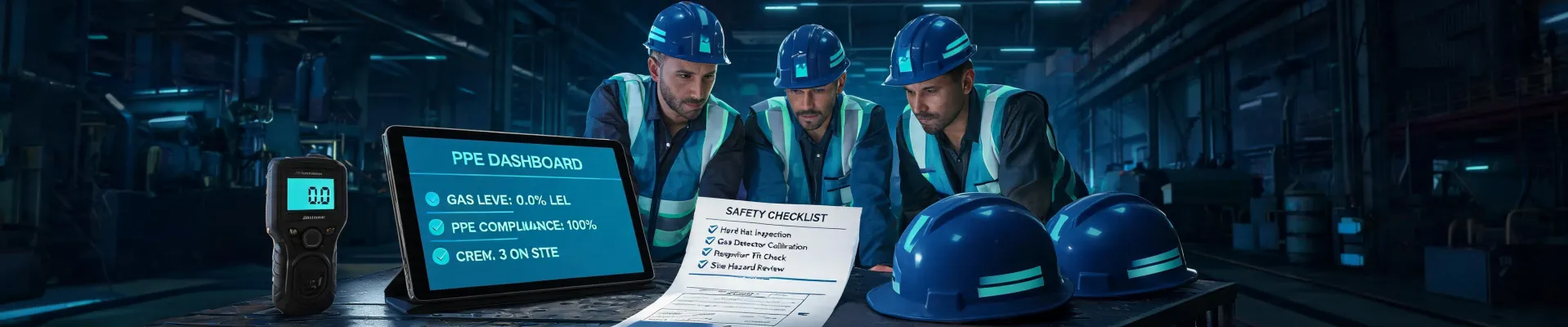
Let's start with something that might make you stop scrolling: in a controlled drop test, an MSA V-Gard safety helmet and a Milwaukee hard hat will both pass the same ANSI Z89.1 standard. The V-Gard often costs more. So is the extra money just branding?
Not exactly. In my role coordinating emergency PPE orders for industrial plants, I've learned spec sheets only tell you a fraction of the story. In March 2024, a plant manager called at 10 p.m. because his crew's hard hats were coated in dry chemical powder after a fire extinguisher discharge. He needed to know whether to clean them or replace them by the morning shift. If he guessed wrong, he was facing a shutdown penalty. We made it. That call is a big reason I take this comparison seriously.
Here's the framework I use with field teams:
- Compliance and shock absorption
- Comfort under realistic conditions, not just in a demo
- Long-term durability after chemical exposure or fire suppression
- The company behind the product
Compliance: They Both Pass. That's the Wrong Benchmark.
OSHA's head protection rule (29 CFR 1910.135) requires helmets to meet ANSI Z89.1. Both MSA V-Gard and Milwaukee hard hats have certified options. On paper, that means both are legal to use.
But compliance is table stakes. The standard doesn't tell you how a shell handles a grazing impact, a splash of solvent, or three years of bouncing around in a work truck. That's where the real comparison starts. And with the V-Gard line, MSA even offers models with MIPS — a multi-directional impact protection system that originated in cycling helmets. That's a signal of how fast industrial PPE is changing.
Fit and Wearability: The First Impression Is a Trap
If you hand someone a Milwaukee hard hat for the first time, the ratchet feels smooth. The padding feels plush. It's a genuinely comfortable hat right out of the box.
Here's the catch: after a full shift, that initial comfort can fade.
We tested both with a crew of 14 boilermakers on a two-week project. Seven said the Milwaukee ratchet was easier to adjust on day one. By day four, nine of the 14 said the MSA V-Gard was the one they forgot they were wearing. The V-Gard's suspension spreads pressure more evenly across the head. The Milwaukee felt more like it sat on specific points over time.
The frustrating part is that most committees make this decision in a five-minute demo. That's exactly backwards.
After the Fire: Cleaning, Inspection, and the Hidden Trap
That March 2024 call is the perfect example of why this matters. The crew's helmets passed an ANSI standard. They were covered in ABC dry chemical powder. And on a rushed night call, it's tempting to just say wipe them off and keep working.
How to Clean Fire Extinguisher Residue
The short version:
- Let the dust settle. Don't use a leaf blower or a hose. ABC dry chemical is extremely fine, and blasting it makes it airborne and harder to control.
- Wear an N95 or P95 mask and gloves. Monoammonium phosphate can irritate your lungs and skin.
- Vacuum first. A HEPA vacuum lifts the loose powder. Water turns it into a paste that's miserable to remove.
- Wipe with a damp cloth. Water alone usually works on the remaining film. For stubborn residue, a little isopropyl alcohol is okay.
- Never use solvents on the shell. Acetone, brake cleaner, or paint thinner can soften the plastic even if it looks fine.
I've made the mistake of rushing this inspection. I knew I should check every suspension point after an incident, but thought “what are the odds?” Then a returned helmet collapsed when a worker put it on. Nobody got hurt, but it was a wake-up call.
On durability, my experience splits. The MSA V-Gard generally handles the cleanup process better. Its shell material seems more resistant to the mild chemical wiping that follows a discharge. I've seen more hairline cracks and heat distortion on Milwaukee helmets after the same event — not because they're cheap products, but because the shell composition is optimized differently.
If there's any doubt after a fire — or any significant impact — replace the helmet. Most manufacturers recommend it. That's not a sales pitch; it's the standard.
Why MSA Safety CEO Leadership Matters in a PPE Program
Buying a helmet is also buying the company behind it. MSA Safety has been around for over a century. Under CEO Nish Vartanian, MSA has pushed well beyond hard hats into connected gas detection, cloud-based compliance tools, and integrated fall protection. That matters when you're building a PPE program for the next decade, not just filling a cabinet.
Milwaukee brings a different angle: job-site innovation and a tool ecosystem that construction crews love. That's real. But for industrial emergency response, the MSA ecosystem is a better fit.
What was best practice in 2020 may not apply in 2025. The industry is evolving. PPE performance isn't only about passing a drop test anymore — it's about data, support, and total lifecycle cost.
Which One Should You Order?
If you manage a plant with chemical exposure, heat, or emergency response needs, I'd default to the MSA V-Gard Safety Helmet. It's not flashy. It just holds up.
If you run a construction crew that wants integrated lighting, accessory compatibility, and a plush first feel, the Milwaukee hard hat deserves a trial.
Here's my real advice: order a few of each. Have your people wear them through a full shift. Then, after six months of abuse, compare them. That test beats any spec sheet.
I don't have hard data on every brand's field failure rate, but based on hundreds of emergency orders, the pattern is clear: the best helmet is the one people actually wear — and the one you can support with parts and documentation for years. For me, that's still the V-Gard.

Jane Smith
I’m Jane Smith, a senior content writer with over 15 years of experience in the packaging and printing industry. I specialize in writing about the latest trends, technologies, and best practices in packaging design, sustainability, and printing techniques. My goal is to help businesses understand complex printing processes and design solutions that enhance both product packaging and brand visibility.