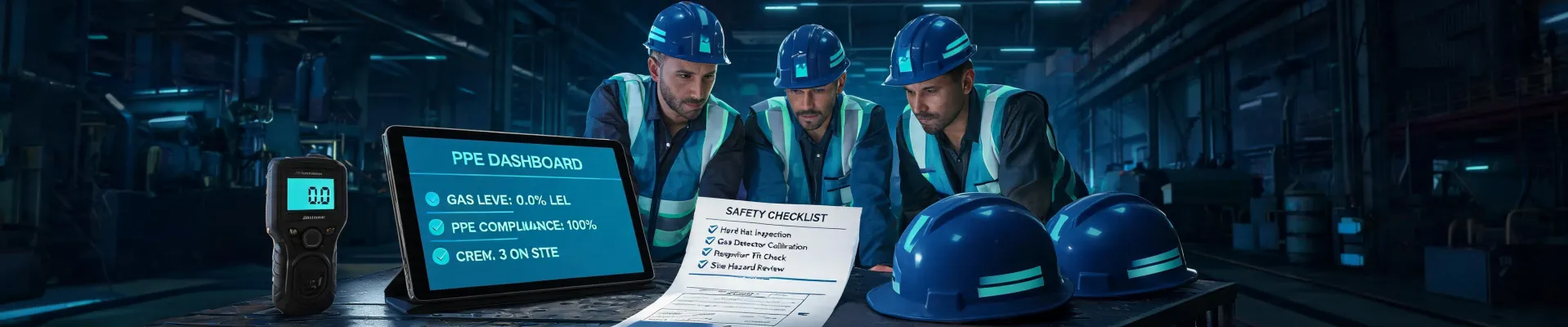
The Short Answer: Safety Compliance Isn't About Having the Most Certifications
After a decade of ordering safety gear, I've learned that the biggest mistake isn't buying the wrong brand—it's buying gear that looks compliant on paper but doesn't match the actual hazard. The most expensive order I ever processed was for 200 V-Gard hard hats that were perfect for construction but completely wrong for a chemical washdown area. That mistake cost us about $3,200 in restocking fees and a two-week project delay.
Here's what I wish someone had told me in 2017: the difference between a 'compliant' purchase and a 'safe' purchase is usually hidden in the fine print of the product specification sheet.
How I Learned This Lesson (The Hard Way)
My First Year Disaster (2017)
In my first year handling safety orders, I was basically just matching model numbers to a list our EHS manager gave me. I thought, 'Hey, a hard hat is a hard hat, right?' Wrong. I ordered 150 MSA V-Gard hard hats for a crew that spent 80% of their time working near electrical hazards. The V-Gard is a great helmet, but I had ordered the standard model without the electrical insulation rating. The crew supervisor caught it before they went on-site, but the embarrassment was real.
Cost of that mistake: about $450 in rush shipping to get the correct V-Gard electrical-rated models, plus a half-day of explaining to my boss why I'd ordered the wrong thing.
The N95 Mask Confusion (2022)
During the pandemic, everyone was scrambling for N95 masks. I placed a large order for what I thought were NIOSH-approved N95 respirators from a distributor I'd used for years. The boxes arrived, and they had the right markings—'N95,' 'NIOSH,' the whole deal. But when our safety officer spot-checked them, he noticed the packaging was slightly off. A quick call to the manufacturer (not MSA in this case, but a similar scenario) confirmed they were knockoffs.
Cost of that mistake: We had to return an entire pallet of masks. The supplier refunded us, but we lost a week of work while our team was unprotected. That's when I created our first product verification checklist.
The 'Why Did My Fire Alarm Randomly Go Off?' Episode (2024)
Okay, this one wasn't directly a purchasing mistake, but it taught me a lesson about placement and specs. We installed a new MSA gas detection system in a workshop. It kept triggering false alarms for seemingly no reason. After three service calls and a lot of frustration, we realized the installers had placed the detector too close to a solvent-based cleaning station. The sensors weren't faulty—the environment was wrong for that specific model.
Cost of that mistake: Three service calls at $200 each, plus $560 in lost production time because the workshop kept getting evacuated. A simple check of the installation manual would have prevented this.
The 3-Point Pre-Check That Changed Everything
After the mask fiasco in 2022, I developed a three-point pre-check that we run on every single order now, especially for high-value items like MSA fall protection harnesses, gas detectors, and respiratory protection. It's basically saved us from about 15 potential disasters in the last 18 months.
1. Match the Gear to the Specific Hazard, Not Just the Job Title
Most buyers focus on the job role—'these are construction workers, so they need hard hats.' The question they should ask is: 'What specific hazard will they face today?' A welder on a construction site needs different eye protection (with a darker shade lens) than an electrician. A worker near a chemical bath needs a different type of respirator than one dealing with airborne dust. In my experience, 90% of safety gear returns are because the gear was 'appropriate' for the broad job category but wrong for the specific task.
Check the MSA Safety product spec pages carefully. Look for the 'Application' section. If it doesn't list your specific hazard (e.g., 'splash protection,' 'arc flash'), you're probably buying the wrong thing.
2. Never Trust Just the Box Label—Verify the Source
Counterfeit safety equipment is a massive problem. I'm not saying your regular distributor is selling fakes, but the supply chain can get murky. After the mask incident, I made a rule: if an order is over $1,000 or involves life-critical gear (like a self-contained breathing apparatus for fire service), we call the manufacturer to verify the distributor's authorization. Honestly, it takes 10 minutes. It's way cheaper than the alternative.
For MSA Safety, you can check their 'Where to Buy' section on their website. It lists authorized distributors. It's a simple step that most safety managers overlook.
3. Read the Installation and Maintenance Guide Before You Buy
I know this sounds like a pain, but the fire alarm incident taught me that 'compatible' doesn't always mean 'perfect.' If you're buying a fixed gas detector or a complex fall arrest system, download the manual PDF first. Check the operating temperature range, the required clearance, the maintenance schedule. One time, we bought a nice MSA Skullgard helmet for a foundry worker, but the manual said it had a max service temperature of 300°F. The foundry floor hit 350°F in summer. Another order that had to go back.
When This Advice Doesn't Apply
This pre-check is overkill for small, low-risk items. If you're ordering basic safety glasses for an office tour, don't spend an hour verifying specs. Also, if you're buying from a direct, long-standing relationship with a single supplier (like a strategic partnership with an MSA channel partner), you can probably skip step #2.
The real value of this checklist is for medium-to-high consequence items where the cost of failure—in both dollars and safety—is high. For routine PPE like standard hearing protection? Just buy the bulk box and move on.
Conclusion: The Real Value of 'Prevention'
I honestly don't have a perfect record. I still order the wrong thing sometimes. But the 12-point checklist I created after my third mistake has saved us an estimated $8,000 in potential rework over the last 18 months. More importantly, it's prevented us from sending a worker into a situation with the wrong gear. That's the real metric that matters.
The most expensive safety equipment is the one that doesn't work for your specific hazard. A little bit of pre-work—verifying the spec, the source, and the environment—takes 20 minutes per order. It's basically the cheapest insurance you can buy.

Jane Smith
I’m Jane Smith, a senior content writer with over 15 years of experience in the packaging and printing industry. I specialize in writing about the latest trends, technologies, and best practices in packaging design, sustainability, and printing techniques. My goal is to help businesses understand complex printing processes and design solutions that enhance both product packaging and brand visibility.