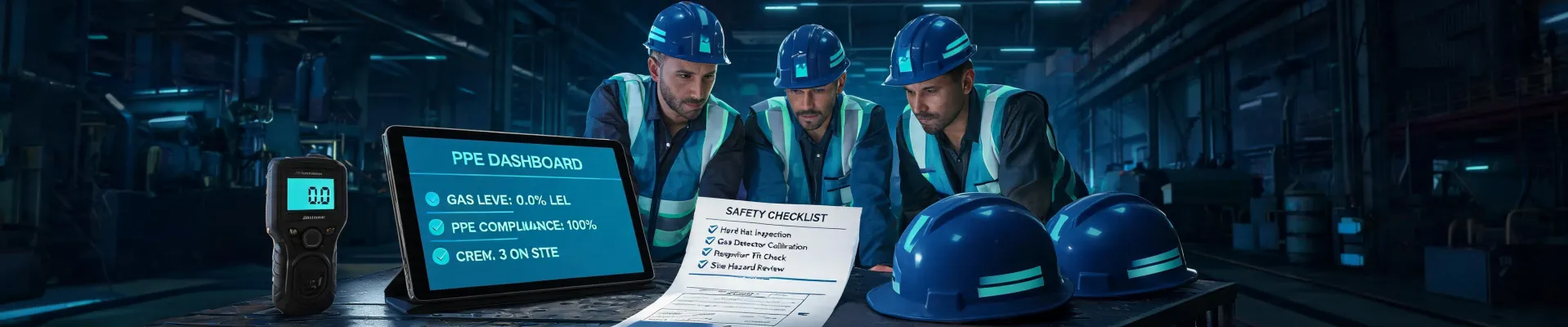
Let me be blunt: if you think you can tell if a safety harness or hard hat is safe just by looking at it, you're wrong. I'm not saying this to be dramatic. I'm saying this because I've managed safety for industrial crews for close to a decade, and the worst failures I've seen—the kind that could have killed someone—were on gear that looked perfectly fine. The real danger isn't the equipment with a visible crack; it's the harness that's been in the sun for five years but still has that "new-ish" sheen.
My argument is simple: You cannot visually inspect compliance or safety. You need a date-code system. Period.
I know the counter-argument. I've heard it from foremen and safety officers on nearly every site I've worked. "We do a daily visual check. If the stitching is good and there are no cuts, it's good to go." That's a comfortable mindset. It's also a trap (one I nearly fell into myself).
The near-miss that changed my mind
In late 2023, I was supervising a crew for a large-scale refinery turnaround. A veteran rigger—a guy with 20 years of experience—was pulling his MSA V-Series harness from his truck. He gave it the usual look-over: a quick tug on the D-rings, a glance at the webbing.
"This one's fine," he said. "I've had it for maybe two years."
Something didn't sit right. Not because I saw a problem, but because he was so sure without any evidence. I asked him to check the label. He peeled back the worn cover and the date code was nearly illegible, but we could make out a pattern. It was a harness we'd ordered in 2017. Six years old.
He was embarrassed. I was nervous. That harness was a ticking time bomb, and neither of us knew it until we looked at a tiny, fading tag. We got lucky—that was a happily-ever-after story. I knew then that our reliance on institutional knowledge ("Bob says this is new") was a process gap (unfortunately). We didn't have a formal lifecycle tracking system. That saved-our-skin moment cost us only our pride (finally!).
The data sinks in: why we can't trust our eyes
After that incident, I looked into the actual standards. According to OSHA and manufacturers like MSA, the safety of PPE is not solely a matter of visual integrity. The degradation is often microscopic.
Consider these factors:
- UV Exposure: UV light weakens polymers (the plastic in hard hats and nylon webbing). You can't see the molecular breakdown. A helmet left on a truck dashboard for a summer might look pristine but have significantly reduced impact resistance.
- Chemical Invisibility: A harness that looks clean may have been exposed to a chemical mist three weeks ago. That chemical exposure can degrade the fibers by 30% or more without any visible discoloration. You spot it? (Spoiler: You probably won't.)
- Heat Stress: Hard hats stored in a hot toolbox or near a furnace can become brittle. The shell might not crack on impact—it might shatter.
The point is, we are asking our safety mangers to be material scientists with 20/20 vision. That's a foolish ask. An automated process—using date codes and a simple spreadsheet or app—eliminates the data entry errors we used to have with our old "check-the-box" paper system. Switching to this efficient method cut our annual inspection time from three days to about four hours.
How to implement a date-code system (the practical way)
I know what you're thinking: "This sounds great, but I have hundreds of pieces of gear on site. It'll take forever." It seems like a lot of work, but it's fairly straightforward once you have a process.
- Establish your lifecycles now. MSA hard hats generally have a maximum service life of 5 years from the date of manufacture. Harnesses can vary from 3-5 years depending on use and environment. Check the manufacturer's tag or website (msasafety.com) for specific guidance.
- Use a permanent marker, but do it right. Don't write on the label (it fades). Get a set of paint markers or a label maker. I like to write the retirement date directly on the shell of the hard hat or the back pad of the harness. Something like: "R - 2027" so anyone can see it.
- Do a quarterly purge. Every three months, walk the site with a list of assets. The first time you do this, you will likely find 5-10% of your gear is already expired. That's okay. That's the cost of finding the gap.
In my experience, the hardest part is the first month. After that, it becomes routine. The best part of finally getting our vendor process systematized: no more 3am worry sessions about whether the order will arrive (or if that harness will hold my weight). You hit 'confirm' on the inspection and immediately feel a sense of satisfaction.
But what about the 'it's probably fine' crowd?
I hear the objection: "This is overkill. We're a small crew. I've been in the industry for 20 years, and I've never had a problem."
To that, I say: the industry standard is not based on your luck. It's based on statistical data that confirms the risk is real, even if you personally haven't seen it. The color matching tolerance in printing is Delta E < 2 for a reason (Reference: Pantone guidelines). If we can hold a color to that standard, we can certainly hold a life-saving device to a standard that eliminates guesswork. A 'looks good' system is like driving without a seatbelt—it works fine until the one time it doesn't.
My position hasn't changed. I believe visual inspection is still a part of the daily check (check for obvious damage like cracks, cuts, or fraying). But the real safety net? It's the date. It's the process. It's the system that eliminates the human error of thinking, "This looks fine."

Maeve Callahan
Maeve Callahan is a head-protection analyst covering Type I and Type II hard hats, climbing-style safety helmets, bump caps, chin straps, suspensions, liners, and face-shield carriers. She applies ANSI Z89.1, EN 397, and EN 12492 criteria while comparing impact attenuation, penetration resistance, lateral deformation, electrical class, retention strength, field of vision, mass, fit range, and temperature conditioning. Her guides help EHS teams, contractors, utilities, and buyers select helmet systems for overhead hazards, work at height, electrical exposure, accessory compatibility, and worker acceptance.