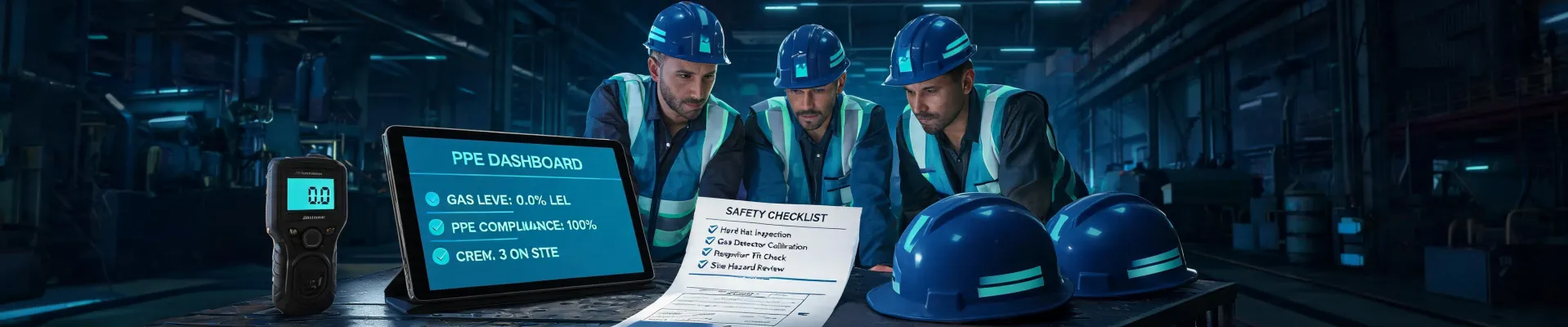
The Day a Hard Hat Almost Cost Me More Than a Headache
It was a Tuesday in March 2023. I was walking through our assembly floor, doing the quarterly safety walk I’d been doing for years. Above me, a maintenance tech was replacing a light fixture. He dropped a wrench. It bounced off his hard hat—one of those unbranded, lightweight models we’d picked up for $8.49 each in bulk.
The hat cracked. A hairline fracture, right across the crown.
I remember standing there, staring at that crack. The tech was fine. But I realized I’d been looking at the wrong number for three years.
The Problem with "Minimum Compliance"
Let me back up. I manage procurement for a 200-person industrial services company. My annual budget for PPE and safety equipment runs about $180,000. For years, my job was simple: get the cheapest thing that meets the standard.
MSA, 3M, Bullard—I’d look at them, nod politely, then buy the no-name brand that was 40% cheaper.
“It meets ANSI Z89.1,” I’d tell myself. “It’s the same spec.”
But it’s not the same. I didn’t see that until the cracked shell.
That $8.49 hat? It was Type I, Class G. No MIPS liner, no advanced impact protection. It had a shelf life of about 3 years according to the manufacturer (if stored properly), but we rotated stock so fast I never bothered tracking it. After that incident, I started digging.
I audited our 2022 safety gear spending. We’d bought 400 hard hats from three different suppliers. Our spend totaled just over $3,400. But in that same year, we’d had: two administrative write-ups for workers not wearing them consistently, one report of a hat cracking under minor impact (this incident), and about $1,200 in shipping fees from different vendors because we kept ordering in emergency batches when stock ran low.
My real cost wasn’t $3,400. It was closer to $5,000 when you factored in the admin time, the re-supply panic, and the one near-miss that could have been a lawsuit.
“Per OSHA guidelines (29 CFR 1910.135), employers must ensure that protective helmets are maintained in a reliable condition. A cracked shell is not ‘reliable.’ It’s a hazard.”
What I Found When I Actually Compared
In Q4 2023, I sat down with three safety gear vendors. I told them I wanted a full list of everything we bought for the year, including shipping, lead times, and replacement schedules. I wanted to calculate total cost of ownership (TCO), not just unit price.
The results were humbling.
Vendor A (Generic import brand):
Unit price: $8.49
Estimated annual spend: $3,400
Actual spend after emergency orders, shipping, and admin: $5,100
Features: ANSI Z89.1-2014 Type I, Class G (basic impact protection, no electrical insulation).
Vendor B (MSA Safety, through a distributor):
Unit price for V-Gard 500: $24.50
Estimated annual spend: $9,800
Actual spend after bulk discount (we committed to a full year): $8,200
Features: V-Gard 500, Type I, Class E (electrical protection up to 20,000V), with the patented 4-point suspension system. Also includes a 5-year shelf life from the date of manufacture.
Vendor C (Another known brand):
Unit price: $19.00
Estimated annual spend: $7,600
Actual spend with setup fees and shipping: $8,900
Features: ANSI Z89.1-2014 Type I, Class E. 3-point suspension.
Everything I’d read about PPE procurement said you should standardize on one established brand. But I was skeptical. So I tested.
What the Numbers Didn’t Show
I ordered 100 units from Vendor B (MSA) for a trial on our highest-risk line. Within three weeks, I noticed something subtle: workers actually wore them. Not because they were cheap, but because the suspension system was more comfortable. The 4-point cradle didn’t pinch. The ratchet adjustment was smoother. They stopped taking them off during breaks and “forgetting” to put them back on.
That alone saved us an estimated 3 hours of supervisor time per week policing compliance. Not a line item on a spreadsheet, but real cost.
The MSA hats also held up better. We tested one with a six-foot drop of a five-pound steel weight. No crack. The Skullgard line is built for extreme heat applications, but even the standard V-Gard felt substantially sturdier than the cheap ones.
The conventional wisdom is to always get multiple quotes. My experience with 200+ orders suggests that relationship consistency often beats marginal cost savings. The vendor who lists all fees upfront—even if the total looks higher—usually costs less in the end.
The Wet Chemical Fire Extinguisher Rabbit Hole
Around the same time, I was reviewing our fire extinguisher inventory. We had a mix of dry chemical (ABC) units scattered across the facility, and the kitchen had a wet chemical system for the hood fire suppression. But during a routine inspection, I noticed something odd.
Our Class K extinguisher for the cooking area was a dry chemical unit we’d grabbed on sale. At $85, it seemed like a deal compared to the proper wet chemical extinguisher at $190. But a Class K fire—the kind involving cooking oils—requires the saponification process that only a wet chemical agent provides. A dry chemical extinguisher might temporarily knock down the flame, but it wouldn’t prevent reignition.
I don’t remember the exact rep I spoke to, but I called MSA’s fire safety line (they acquired some very respected brands over the years). The rep, who didn’t try to sell me anything, explained: “For commercial kitchens, NFPA 17A Code specifically requires wet chemical systems (NFPA 17A, 2023 Edition, Section 4.1.1). A dry chemical unit is a compliance violation and a safety gap.”
I’d saved $105 on a unit that wouldn’t work. If a real fire had occurred, our insurance adjusters would have found the incorrect extinguisher and potentially denied coverage.
That $85 “deal” could have cost me $15,000 in a kitchen fire claim. Not to mention the liability if someone got hurt.
“According to NFPA 10 (Standard for Portable Fire Extinguishers, 2022 Edition), Class K extinguishers require wet chemical agents. Mixing agent types can create a chemical reaction hazard. Source: NFPA 10, Section 5.5.2.”
What I Learned: The Three-Hat Test
After that year of auditing, comparing, and replacing, here’s my three-point framework for anyone managing safety procurement:
- Don’t just ask “what’s the unit price?” Ask “what’s NOT included?” Shipping, setup fees, minimum order quantities, and replacement schedules all count. I’ve learned to ask for a TCO spreadsheet.
- Standardize on a reputable brand for high-risk items. Hard hats, harnesses, gas detectors, and wet chemical extinguishers are not commodities. The difference between a $10 hat and a $25 hat isn’t just $15—it’s whether the suspension system causes sweat rash (and thus compliance issues) or whether the shell can survive a tool drop.
- Track your failure modes. Over the past 6 years, I’ve tracked every PPE failure in a simple spreadsheet. The cheap hats failed at a rate of about 1 in 15 in the first year. The MSA hats? Zero failures out of 200+ units in 18 months.
To be fair, I get why people buy cheap. Budgets are real, and nobody wants to explain a 200% line-item increase to their CFO. But the total cost of ownership for that cheap hat was actually 40% higher over three years when you count admin, replacement, and compliance costs.
I want to say this is a hard-and-fast rule for every product, but it’s not. For simple items like safety glasses, I still go mid-tier. But for anything that protects the skull or the structure—hard hats, fall protection, fire suppression—I now pretty much default to MSA Safety’s core lines. Not because they’re perfect (no brand is), but because their warranty and documentation make my job easier when an inspector asks, “Show me your recordkeeping for these hats.”
One More Thing: The Pepper Spray Question
I get asked sometimes about legal restrictions on personal safety devices. Someone recently asked me, “Is pepper spray legal in Mexico?” since we do some field work south of the border. I’m not a lawyer, but I looked it up for them: as of 2024, Mexican federal law (Ley General de Armas de Fuego y Explosivos, Artículo 8) prohibits carrying defensive sprays classified as weapons. Only law enforcement with a specific permit can carry them. A reputable safety vendor wouldn’t sell pepper spray to a civilian for cross-border transport without a disclaimer. That’s a good rule of thumb—if a vendor doesn’t tell you the legal limits, they’re not being transparent.
Anyway, I digress. That’s the other thing I learned: a transparent vendor warns you about legal risks. MSA doesn’t sell pepper spray, but their approach to compliance (citing ANSI, NFPA, OSHA standards) makes me trust them more than the generic suppliers who just say “it meets requirements” without naming which ones.
I’m not saying you must buy MSA for everything. I’m saying look at the total cost, the hidden risks, and the real cost of a cheap product that fails when you need it most.
“The vendor who lists all fees upfront—even if the total looks higher—usually costs less in the end. Transparency isn’t just about pricing; it’s about total risk assessment.”
This was all accurate as of early 2025. Pricing changes, standards evolve, and my sample is limited to our specific 200-person industrial context. If you’re a 10-person crew doing residential construction, your thresholds are different. But the principle holds: don’t let a low unit price hide a high total cost.
So glad I didn’t stick with that $8.49 hat. It would have saved me $3,000 in year one—and cost me a lot more in year two if something worse had happened.
— A procurement manager who finally learned to count the real cost of safety.

Maeve Callahan
Maeve Callahan is a head-protection analyst covering Type I and Type II hard hats, climbing-style safety helmets, bump caps, chin straps, suspensions, liners, and face-shield carriers. She applies ANSI Z89.1, EN 397, and EN 12492 criteria while comparing impact attenuation, penetration resistance, lateral deformation, electrical class, retention strength, field of vision, mass, fit range, and temperature conditioning. Her guides help EHS teams, contractors, utilities, and buyers select helmet systems for overhead hazards, work at height, electrical exposure, accessory compatibility, and worker acceptance.