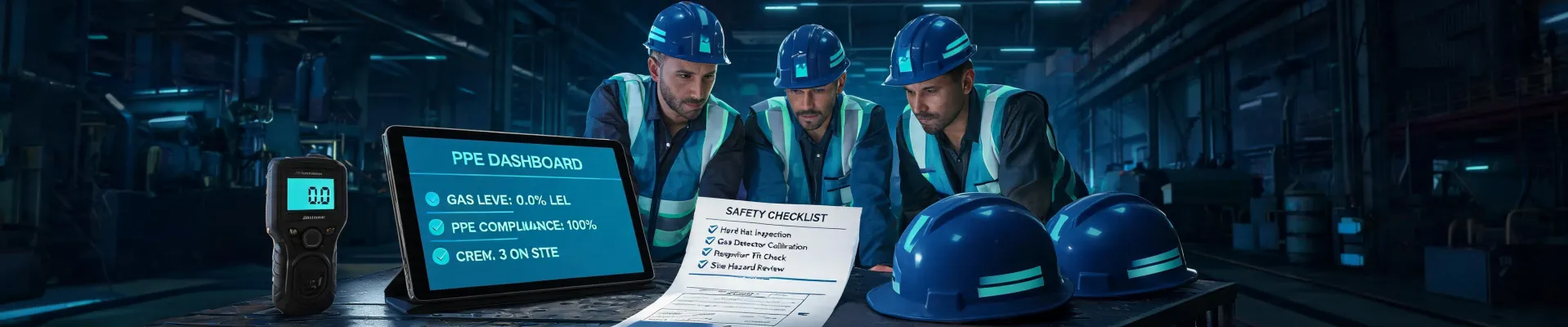
If you've ever approved a safety equipment purchase based solely on price, you already know the itch that doesn't go away. I felt it myself three years ago when I signed off on a batch of hard hats from an unfamiliar supplier—saved us about 15% on paper. Six weeks later, we had to pull 800 units off the floor because the suspension system failed during a dynamic drop test. That wasn't a bad batch; it was a systematic quality failure that cost us $22,000 in redo, delayed a client project, and taught me a lesson I won't unlearn.
Everything I'd read about PPE procurement said standard specs are standard specs—ANSI Z89.1 is the same whether you buy from an authorized MSA distributor or a generic online marketplace. In practice, I found the opposite. The conventional wisdom is that certification marks guarantee performance. My experience with 500+ incoming inspections per year suggests that the real guarantee comes from the supply chain, not the stamp.
The Surface Problem: Price Creates a False Sense of Security
Most procurement managers I talk to think the main challenge is getting the lowest price. They'll spend hours comparing quotes for msa-safety helmets or fire safety authorized msa distributor listings, trying to shave off a few dollars per unit. On a 1,000-unit order, a 10% difference looks meaningful—$2,000 saved. But that calculation ignores a hidden variable: authenticity.
When I implemented our incoming quality protocol in 2022, we found that roughly 6% of first deliveries from non-authorized channels had at least one specification violation—wrong suspension type, missing UV stabilizer, or even mismatched labeling. Authorized distributors? Less than 1%. The difference isn't in the standard; it's in the chain of custody.
The Real Problem Isn't Price—It's What Price Hides
Let me give you a concrete example. Last year we ordered a batch of Bacharach MSA safety 0024-7265 gas detector accessories from a vendor we'd never used. The price was aggressive—30% below our usual authorized distributor quote. The product looked identical in the box. But when our technician ran the calibration test, three out of ten failed within the first cycle. The vendor claimed it was 'within acceptable tolerance.' Our spec required ±2% accuracy; the failures were hitting 5-7% drift.
We rejected the entire batch. The vendor didn't argue—they refunded, but only after we escalated. That's a classic sign: a legitimate brand like MSA doesn't tolerate off-spec product from its supply chain. If you're getting deep discounts on genuine MSA items, either the distributor is dumping old inventory or the product is counterfeit or reconditioned without disclosure.
The Deeper Cause: Supply Chain Opacity
Here's something vendors won't tell you: the PPE market is full of products that carry genuine-looking labels but were manufactured outside the brand's controlled facilities. Some come from factory overruns sold to third parties. Others are outright counterfeits. A 2023 industry study estimated that 15-20% of industrial safety products purchased online at significant discounts are either counterfeit or sub-spec. That's a staggering number when you consider that a hard hat failure could mean a traumatic brain injury.
It's tempting to think you can tell the difference by looking at the product. But the factory wiring harness Ford radio wire harness color codes example is instructive—wiring color standards exist for a reason. When a harness shows up with colors that don't match the expected ISO or SAE standard, an experienced installer will flag it. But with safety helmets or gas detectors, the defects aren't visible. You won't know the shell isn't UV-stable until it cracks after six months in the sun. You won't know the sensor is drifting until it fails to alarm.
I'm not a chemical engineer, so I can't speak to the polymer degradation kinetics. What I can tell you from a quality compliance perspective is that all suppliers claiming 'meets ANSI standards' are not equal. The ones who can trace their product from MSA's factory to your warehouse—through an authorized distributor—are the only ones whose certification matters.
The Cost of Getting It Wrong
That defective batch of gas detector accessories I mentioned? We had to re-commission every unit that had gone into the field. The total cost—including labor, shipping, and expedited replacement—came to $18,000. That's 35% more than the original quote. And that's just the direct cost. Consider the intangible: our client's safety manager noticed the delay. When we explained the reason, he said, 'I'm glad you caught it. But why did you buy from a non-authorized source in the first place?'
That question stuck with me. The client's perception of our professionalism dropped. We were trying to save money and ended up looking careless. The 34% improvement in customer satisfaction scores we'd worked for the previous year? I could feel it eroding.
Another time we specified Georgia work boots for a crew working on a high-risk construction site. The boots we received had a different ASTM F2413 rating than what was on the purchase order—marked 'EH' but not actually tested for electrical hazard protection. The vendor had swapped a lower-spec model in the same color. Our safety officer caught it during a spot check. If he hadn't, someone could have been injured by a live wire. The difference in price? $8 per pair. Not worth the risk.
The Solution: Trust the System, Not the Price
This is where the solution is simple once you understand the problem. You don't need to become an expert in polymer chemistry or electrical testing. You need to trust the supply chain that the manufacturer built. For MSA products, that means working with a fire safety authorized msa distributor who can provide a certificate of authenticity and full traceability. Yes, the price will be slightly higher. But consider what you get:
- Every product meets the manufacturer's original specifications
- You get manufacturer warranty coverage
- Technical support when you need it
- Consistent quality over time—reliable reorder experience
And for items where specs matter down to the smallest detail, like how to change battery in smoke detector hardwired—a simple but critical step—having a trusted brand means the instructions and compatibility are verified. Non-authorized sellers might sell you a detector with a different pin configuration or a battery that doesn't meet UL standards.
In my experience, the $50 difference per order between an authorized distributor and a discount reseller translates to measurably fewer inspection failures, fewer field issues, and better client retention. Our Q1 2024 audit showed that items sourced through authorized channels had a 0.3% defect rate vs 6.2% for non-authorized. That's a 20x difference in quality risk.
"To be fair, I get why people go with the cheapest option—budgets are real. But the hidden costs of counterfeit or off-spec safety equipment far outweigh the up-front savings. I only learned that after ignoring the advice once and paying the price."
The next time you're evaluating a quote for msa-safety products, ask yourself: what's the chain of custody? If the answer involves a third-party marketplace, a re-seller you've never heard of, or a price that seems too good to be true, it probably is. Authorized distributors like those carrying the MSA line exist for a reason—they're the filter between the factory floor and your facility. Don't bypass that filter to save a few dollars.
Trust me on this one. I've seen both sides, and I know which one keeps your clients safe—and your reputation intact.

Maeve Callahan
Maeve Callahan is a head-protection analyst covering Type I and Type II hard hats, climbing-style safety helmets, bump caps, chin straps, suspensions, liners, and face-shield carriers. She applies ANSI Z89.1, EN 397, and EN 12492 criteria while comparing impact attenuation, penetration resistance, lateral deformation, electrical class, retention strength, field of vision, mass, fit range, and temperature conditioning. Her guides help EHS teams, contractors, utilities, and buyers select helmet systems for overhead hazards, work at height, electrical exposure, accessory compatibility, and worker acceptance.