Somewhere this morning, someone typed "how to remove first alert smoke detector" into a search box. Somewhere else, someone typed "smoke detector blinking green" and hoped the internet would explain whether their house was on fire. The answers are short: on most First Alert models you twist the whole unit counterclockwise to pop it off its base, and a blinking green light means AC power is present—not a problem. Five seconds of knowledge turns a minor household mystery into a non-issue.
I think about those searches a lot, because I see the same pattern in industrial safety, where the stakes are higher. I'm the quality compliance person for a company that supplies safety equipment. I review roughly 200 unique items a month—hard hats, gas monitors, fall harnesses, fire extinguishers—before they go out to customers. Maybe 180 in slower months; I'd have to check the system. In 2024 I rejected around 12% of first deliveries. Reasons: cracked shells, certification labels that didn't match the product, suspension straps heat-stamped wrong.
After four years of this, I've landed on an opinion that surprises people: the premium gear isn't the main problem. The main problem is the small stuff around the gear—the indicator light nobody explained, the inspection step that isn't on any checklist, the replacement part that nobody knew existed. That's what actually fails in the field.
The Blinking Light Problem Follows People to Work
Let's stay with the smoke detector for a minute. A First Alert unit with AC power usually blinks green as a normal status indicator. To remove it, you don't need tools—you twist the body counterclockwise, drop it away from the bracket, and disconnect the plug. These are facts. They are simple, and they're almost never written where the user will see them. So people search, and they wonder, and sometimes they disable the detector because they assume the blinking light means it's faulty.
Industrial gas monitors are the exact same story. A detector chirping by the charging rack is trying to say something specific: low battery, sensor end-of-life, calibration overdue. The pattern is in the manual. But on most sites, nobody posts the indicator chart next to the charger. So when a worker sees an MSA ALTair blinking and beeping at 6 a.m., the instinct is "it's broken," not "it's telling me something." I once stood in a compressor room while a technician stared at a chirping monitor for ten minutes. Turned out to be a low battery. A fresh battery and a quick bump test solved it. He'd simply never been shown what the blink pattern meant. That's not carelessness. That's a gap in the system.
When Did You Last Lift Your Hard Hat?
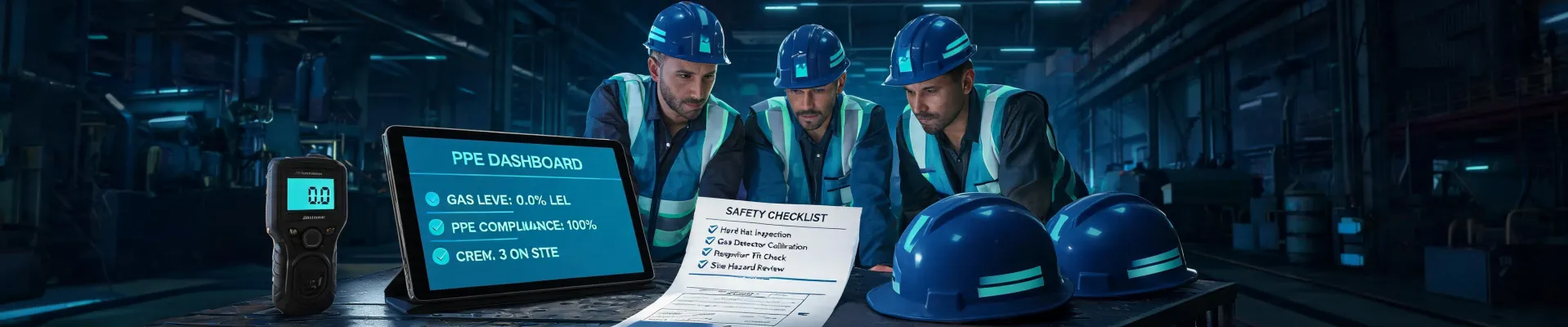
There's a second gap: head protection. I ask crews a simple question on site visits: when did you last lift your hard hat out of its suspension and inspect underneath? Most of the time, the look I get says "you're not supposed to take it apart." You are. The suspension is removable by design, and a lot of important information lives underneath it.
Consider an MSA V-Gard hard hat, one of the most common industrial helmets in North America. The date code is molded into the shell, but you have to remove the suspension to read it. That date tells you when the helmet was made, which is the starting point for any lifespan decision. Shell plastic ages differently depending on environment: UV exposure, heat, chemical fumes, even spray paint overspray can make it brittle. A helmet can look flawless on the rack and be structurally compromised underneath.
ANSI/ISEA Z89.1 sets the performance requirements for industrial head protection. It doesn't hand you a universal "replace after ten years" rule, because reality isn't that tidy. A hard hat stored indoors in a cool supply room ages differently than one mounted on a truck dashboard in Texas. So the practical approach is: inspect on a schedule. Lift the hard hat suspension, hold the shell up to bright light, look for spider-web cracks, chalky patches, stiffness. Read the date code. And if a shell has taken a real impact—a dropped tool, a fall, a low overhead pipe—retire it immediately. No exceptions.
Also: don't paint your hard hats. I've seen a crew lose a whole set of head protection because someone ran a spray can over them for "cosmetic reasons." The solvents in the paint attack the shell material. Manufacturer instructions are clear about this, and the damage is often invisible until it's not. If it's been painted, replace it.
The Replacement Part Nobody Knew Existed
Third gap: replacement parts and calibration get treated as optional spending. When something expensive starts acting up, the default move is to quarantine it and call a technician. Sometimes that's correct. But sometimes the fix is a simple part, and the long wait is an unforced error.
Facility story from 2023. A client had a Bacharach refrigerant detector that started giving erratic readings. The maintenance tech pulled it off the wall, taped a "needs service" note to it, and set it aside. Three weeks later, during an audit, I asked why they hadn't ordered the replacement module. The answer: "we didn't know there was one."
There is. The catalog number shows up as Bacharach MSA Safety 3015-3071. It's the kind of bare-bones component that a competent tech can install in minutes—and the cost is nowhere near the cost of three weeks without detection. I'd quote the current price here, but it changes; what I remember is that it wasn't a budget decision, it was an awareness gap. A refrigerant leak doesn't wait while you schedule a service visit.
There's also the delivery question. When a deadline matters—an audit date, a compliance deadline, a scheduled shutdown—the certainty of having the part in hand is worth a premium. I've paid rush fees many times in this job; in March 2024 I paid extra to get a replacement part overnight because a client's audit was five days away. Maybe sixty dollars. Losing the audit slot would have cost hundreds of times that. Certainty has a price, and it's usually cheaper than the alternative.
What This Costs: An Audit Story
Let me put a concrete number on this. In Q1 2024 I did a walkthrough with a client's safety manager. They had spent properly on head protection—right brand, right procurement. But when I pulled a sample of hard hats from the floor and removed the suspensions, three had date codes beyond ten years old. Two more showed the classic signs of paint overspray. All five looked fine from the outside. Under the suspension, the story changed completely.
The site didn't fail its audit, but it received a written finding on PPE maintenance. The corrective action meant pulling every hard hat on site, logging every date code, retiring fifteen units, rewriting the inspection checklist, and documenting it all. Roughly $1,600 worth of helmets turned into something like $18,000 of labor, downtime, and follow-up work. That's the real price of skipping the one-minute inspection.
And if that sounds like a business problem, reframe it: OSHA's "Fatal Four" statistics include struck-by hazards, which is precisely what head protection addresses. I'm not going to tell you a hard hat guarantees anything, because it doesn't. But a cracked shell that never got inspected is how a near miss becomes an injury.
The Fix Is Boring—That's Why It Works
The solution isn't more expensive equipment. It's making the invisible visible. (Yes, I realize that sounds like a motivational poster. It's also just true.) Four steps cover most of what I find on site visits:
- Put the indicator charts where the equipment lives. If a blinking green light means "normal operation," write that down and post it. In a plant, print the LED explanation chart for your gas monitors and hang it at the charging station. Nobody should need Google at 6 a.m.
- Put the suspension check on the monthly checklist. "Lift hard hat suspension, inspect shell, read date code" takes sixty seconds. It belongs right next to "test fire extinguisher seals."
- Stock the repair parts before you need them. If your facility runs Bacharach gas detection, consider keeping the Bacharach MSA Safety 3015-3071 component in the parts drawer. I realize "inventory" isn't exciting. It's also exactly what turns a three-week wait into a ten-minute repair.
- Buy from manufacturers that document everything. This is where MSA Safety Inc. earns its reputation. The company has been designing industrial safety equipment for over a century, and that history shows up in the details: date codes you can find, replacement parts that exist, service guidance that's actually published. "The Safety Company" isn't just a tagline—it's the reason the answer to most of these questions already exists. The question is whether your team knows to look for it.
I'll end where I started: with the smoke detector. The blinking green light and the twist-to-release base are not difficult concepts. Neither is the date code inside a hard hat, or the part number for a gas detector component. The equipment is designed to protect. But protection is a system, and a system only works when the quiet details are understood. Take five minutes tonight: look at your hard hat's date code, learn the indicator lights on your gas monitor, find the right replacement part before you need it. That's what separates an audit from an accident.

Maeve Callahan
Maeve Callahan is a head-protection analyst covering Type I and Type II hard hats, climbing-style safety helmets, bump caps, chin straps, suspensions, liners, and face-shield carriers. She applies ANSI Z89.1, EN 397, and EN 12492 criteria while comparing impact attenuation, penetration resistance, lateral deformation, electrical class, retention strength, field of vision, mass, fit range, and temperature conditioning. Her guides help EHS teams, contractors, utilities, and buyers select helmet systems for overhead hazards, work at height, electrical exposure, accessory compatibility, and worker acceptance.