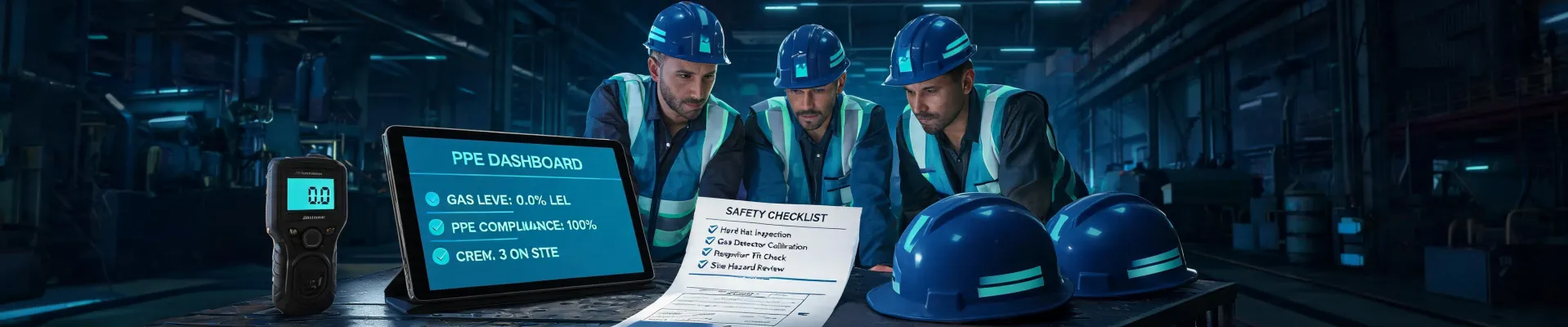
There's no single safety-equipment checklist that works for everyone. I coordinate emergency safety-equipment orders at an industrial supply company, and in the last six years I've processed more than 300 rush orders. The ones that go sideways all share one problem: someone bought the wrong type of gear for the situation.
So before you buy a hard hat, search for “how to change battery in smoke detector,” or compare pull on work boots, stop and figure out which of the three scenarios below you're in. The right question isn't “What's the best safety product?” It's “What hazard am I trying to survive?”
The Three Safety-Equipment Scenarios
I see the same three situations again and again. Each needs a different decision method.
Scenario A: Industrial Head Protection and Gas Detection
If you're a safety manager for a plant, refinery, or large construction crew, you care about certification, calibration, and traceability. That's where MSA Safety comes in. MSA Safety's “The Safety Company” logo on a hard hat isn't just decoration. From the outside, a $30 hard hat and a $90 hard hat look basically the same. The reality is the shell, suspension, and certification testing are different. MSA Safety's V-Gard line, for example, is tested to standards like ANSI Z89.1, and each unit has a lot code that goes back to a test record. When an inspector asks for proof, that logo is a paper trail.
Gas detection is where I see the most hidden costs. In March 2024, 36 hours before a client's refinery shutdown, they called about a Bacharach MSA Safety 3015-3125 replacement sensor. Normal lead time was ten days. We found a vendor with one in stock, paid $450 extra in rush fees on top of the $820 base cost, and delivered it with a calibration certificate. The client's alternative was a $50,000 penalty clause for shutting down late. The first quote we got didn't include calibration or expedited shipping. That's the trap.
People think expensive gas detectors are expensive because of the brand. Actually, it's the other way around: the brands that can charge more are the ones that built the testing and traceability. A gas detector that isn't calibrated is just a plastic box with a screen. You need the certificate that proves it's reading correctly.
What to check in Scenario A:
- Ask for “what's NOT included” before “what's the price.” Calibration certificates, bump-test gas, and overnight shipping can be extras.
- Verify the part number. A replacement sensor for a Bacharach MSA Safety 3015-3125 must match the detector's manual and calibration curve.
- Ask if the price includes a calibration certificate. If not, add the cost and time to your decision.
Scenario B: Personal Gear for Welders and Tradespeople
If you're a welder, electrician, or field technician, you're buying gear that has to survive daily abuse. Two items show up constantly: pull on work boots and a Miller welding helmet.
Pull on work boots—the lace-free style—get a bad rap as “cowboy boots.” But they're often the safer choice in environments with chemicals, molten metal, or mud. No laces means no place for sparks to land, chemicals can't soak into laces, and there's nothing to snag on rebar. The catch is fit. A loose pull-on boot is a hazard. If it slips when you walk, get a different size or style.
For welding, a Miller welding helmet with an auto-darkening lens is a solid tool. I used one last month on a field repair, and the auto-darkening saved my eyes when a spark popped unexpectedly. The counterintuitive part: don't buy the biggest shade range just because a sale page says it's premium. You need the shade number that matches your process. TIG often needs a darker shade than MIG. And the lens batteries don't last forever. Test the helmet before every job, not after the arc starts.
I've seen contractors spend $300 on a boot and then skip replacing the sole. That's backwards. The safety of a work boot is in the toe, sole, and ankle support—not the brand patch. Look for a safety toe, puncture-resistant sole, and electrical hazard rating if you're around live wires.
Scenario C: Home Safety and Smoke Detector Batteries
If you're searching “how to change battery in smoke detector,” you're probably in Scenario C: a homeowner, renter, or facilities person who just heard a chirp.
Here's the surprise. Sometimes you don't need a new battery. The chirp can mean the detector has reached its end of life. In my own house, I changed the battery in a smoke detector, the chirp stopped for a day, then came back. I changed the battery again. Same thing. Then I looked at the date on the back: the detector was more than ten years old. NFPA 72 guidance recommends replacing smoke detectors after ten years. A new battery won't fix an expired sensor.
So if you're asking “how to change battery in smoke detector,” do this: take the detector down, open the battery compartment, put in a fresh 9-volt battery, then check the date code. If it's still beeping after a minute, replace the whole unit. Sealed 10-year detectors don't have a battery you can change—you replace the smoke detector itself.
The most frustrating part of this scenario is that end-of-life chirps sound exactly like low-battery chirps. You think a $7 battery will solve it. It won't. Test your smoke detector monthly by pressing the test button. If it doesn't sound loud and clear, don't just swap the battery—check the age.
A Note on Pricing Honesty
Across all three scenarios, the same mistake gets repeated: people choose the quote with the lowest sticker price without asking what's missing. I've learned to ask “what's NOT included?” before “what's the price?” The vendor who lists all fees upfront—even if the total looks higher—usually costs less in the end.
I do not trust a quote that says “call for details.” That phrase usually means the details will add costs you didn't budget for. In my 300+ rush orders, the cheapest initial quote became the most expensive final invoice more times than I can count. That's why transparency matters: a price is only a real price if you can see everything inside it.
How to Tell Which Scenario You're In
Here's a quick way to sort it out:
- If you're buying for a crew working in a hazardous industrial area, you're in Scenario A. Focus on certifications, part numbers, calibration, and hidden fees.
- If you're buying for yourself to weld, climb, or work outdoors, you're in Scenario B. Focus on fit, task-specific features, and maintaining what you own.
- If you're dealing with a beeping alarm at home, you're in Scenario C. Fix the cause, not just the symptom.
If you're still not sure, ask yourself this: is the gear protecting a group of people, protecting you on a job, or protecting your family at night? That will point you to the right scenario.
By the time you're in an emergency, it's too late to discover that the cheap quote didn't include the thing that actually keeps you safe.
Bottom line: safety gear is an investment, not an expense. You don't need the most expensive option. You do need the one that's been tested, maintained, and priced honestly.

Jane Smith
I’m Jane Smith, a senior content writer with over 15 years of experience in the packaging and printing industry. I specialize in writing about the latest trends, technologies, and best practices in packaging design, sustainability, and printing techniques. My goal is to help businesses understand complex printing processes and design solutions that enhance both product packaging and brand visibility.