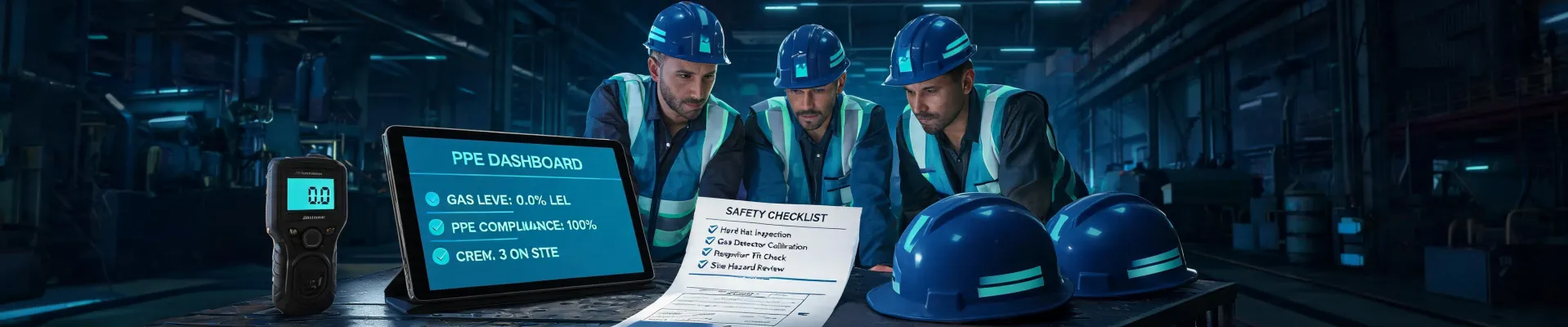
Here's the honest version of my job: I'm a safety coordinator who has ordered, inspected, and retired more PPE than most people. Since 2015, I've made at least six expensive mistakes that totaled more than $4,000 in wasted equipment and lost crew time. The biggest mistake wasn't choosing a bad product. It was choosing a product before I understood the hazard.
MSA Safety makes a lot of tools that are excellent when you match them to the right risk. But I've learned there is no single 'best' MSA Safety item. There is only the right item for your work scenario. In this guide, I'll walk through the scenarios I see most often: head protection, invisible air hazards, fire extinguishers, and boots.
Scenario 1: Something Is Waiting to Hit Your Head
From the outside, a hard hat looks like a hard hat. Thirty years ago, that was close to true. Today, the label matters more than the shell color. The current US head protection standard is ANSI/ISEA Z89.1. Type I covers impact to the top of the head. Type II covers top and lateral impact. The classes G, E, and C tell you whether the helmet protects against electrical hazards. I read that label before I check color. That mistake cost me once, and it will not cost me again.
If you are choosing between the MSA V-Gard H2 MIPS vented safety helmet and what crews call the Green Devil hard hat, stop looking at the outside first. The MSA V-Gard H2 MIPS vented safety helmet makes sense for hot, active work where sweat and long shifts hurt compliance. MIPS stands for Multi-directional Impact Protection System. It is a low-friction layer inside the shell that helps manage rotational energy from angled impacts. The vented shell helps with airflow, but it generally means no high-voltage electrical rating. If your crew works near energized panels or overhead power lines, you need a Class G or Class E helmet, not a vented Class C model.
On many crews, you will still hear people ask for the Green Devil hard hat. I don't judge the nickname. A classic green shell can be perfectly good if it carries a current ANSI/ISEA Z89.1 label, the harness is not worn out, and the helmet has not taken an impact. The problem is treating it as indestructible. UV, heat, paint thinner, and one real impact eventually retire every hard hat. I put a date on every shell now, and I replace any helmet that takes a hit—even if it looks fine in the photo.
What I mean is: the hazard defines the helmet, not the other way around. If you are in a hot warehouse with no electrical exposure, the MSA V-Gard H2 MIPS vented safety helmet is a comfort upgrade that workers may actually keep on their heads. If you are on an older site with low-clearance racks and the crew is used to the Green Devil hard hat, keep it, but keep records. A hard hat only protects while it is worn, adjusted properly, and within its service life.
Scenario 2: The Hazard Is Invisible—Bring an MSA Safety Gas Detector
When workers enter a utility vault, water treatment basin, or chemical storage area, I stop asking about head protection first. I ask: is the air breathable? The person working in that space needs a properly maintained MSA Safety gas detector. Not a phone app. Not a single-gas scan. The detector has to match the gases that actually exist at that site.
I remember a morning when we were ready to enter a pump station. The battery was full. The display showed zero across all readings. On the surface, that looked ready. I skipped the bump test because we were already behind schedule. When the worker opened the cover, he smelled hydrogen sulfide. The detector still showed zero. The sensor had gone dead without warning us. We got lucky. I do not count on luck anymore.
According to MSA Safety's instruction materials, a gas detector should be bump tested before each day of use. A bump test means exposing each sensor to a known concentration of test gas and confirming that the alarm responds. If it does not respond, the instrument is not ready for use, no matter what the battery percentage says. Calibration is a separate process, and it also has to follow the manufacturer's schedule. I put both steps on a shared calendar so they are not optional.
Which MSA Safety gas detector is right for you? That depends on the hazard list. A confined-space entry team usually needs a multi-gas monitor with oxygen, combustible gas, carbon monoxide, and hydrogen sulfide sensors. A site with ammonia or nitrogen dioxide needs a different sensor configuration. I use MSA's ALTAIR series because I know the manual and I can trust the testing dock. But I do not pick a model because a photo looks rugged. I pick it because I have written down what the worker could breathe in that specific job.
In other words: if the air is the danger, the gas detector is not an accessory. It is the main safety device. Give it the same attention you would give a lifeline.
Scenario 3: The Fire Extinguisher Looks Fine Until It Is Not
Before you search 'fire extinguisher recharge near me,' make it a 30-second inspection. I have made this mistake: I saw a full gauge, a clean pin, and a hose that looked okay. I did not look at the service tag. The extinguisher had been sitting in a truck bed for two years after a partial discharge. It would probably have failed when it mattered.
OSHA's portable fire extinguisher rule, 29 CFR 1910.157, requires a visual inspection every month and an annual maintenance check. Most technicians follow NFPA 10 for the details. If an extinguisher has been used, even for a few seconds, the powder or agent inside is not settled the way it should be. It needs professional service or replacement. A used extinguisher is no longer a 'maybe later' item.
Searching 'fire extinguisher recharge near me' is also the wrong first step if the shell is damaged, the tag is missing, or the unit is past its hydrostatic test date. In those cases, recharging does not make sense. A licensed fire protection technician can tell you whether the shell is still serviceable. If the date is current and the only issue is a low or partial charge, that is when you call a certified company and ask if they follow NFPA 10.
I used to keep paper records for extinguishers until an audit turned into a scavenger hunt. Now the monthly inspection lives in the same digital calendar as the gas detector bump tests. That is not about being efficient for the sake of being efficient. It is about eliminating the memory failure that caused most of my expensive mistakes.
Scenario 4: How to Break in Work Boots Fast Without Ruining Them
You can spend a lot on helmets and gas detectors and then overlook the one piece of PPE that carries a worker all day. If you are asking how to break in work boots fast, the real question is whether the boots fit the shape of your foot. Boots that need a violent break-in are often the wrong last shape, the wrong size, or too stiff for the task.
The fastest safe method I have used is simple: buy boots late in the afternoon, because feet swell during the day. Try them on with the socks you will actually wear at work. Then do a staged break-in. Wear them for two hours around the site. Next day, wear them for four hours with lighter duty. If there are no hotspots, start a normal shift on day three. Use a heel-lock lacing technique so your heel does not slide. Heel slip is what causes most blisters.
Do not microwave new boots. Do not bake them in the oven. Do not soak leather boots in water overnight and then walk them dry. Those 'fast' tricks break down the leather, soften the support, and can make the sole separate. You want the material to flex gradually and the footbed to form to your foot—not to destroy the glue and stitching that hold the boot together.
I do not sell boots, and I do not pretend MSA makes work boots. But I include boots in every safety budget conversation because ankle support and slip resistance matter as much as a good hard hat. A worker in pain will think about their feet instead of the gas alarm. That is a hazard.
So How Do You Know Which Scenario You Are In?
Walk the actual work area and answer four questions in order. What is above your head? What is in the air? If a fire started right now, what would you grab? What is on your feet for a ten-hour shift? The answers will point you to the right purchase better than any product ranking.
If the confined-space entry is this afternoon, buy the gas detector before you upgrade the hard hat. If the extinguisher tag is expired, handle that before you shop for a new suspension. If the boots cause blisters, do not tell the worker to 'toughen up'—fix the fit and do a proper break-in. Those are real decisions, not marketing categories.
No piece of MSA Safety equipment makes a workplace 100% safe. I have learned that the hard way. But most of the equipment failures I have documented were predictable. Read the labels, follow the service schedule, and match the product to the hazard. That is the closest thing to a universal answer I can give you.

Maeve Callahan
Maeve Callahan is a head-protection analyst covering Type I and Type II hard hats, climbing-style safety helmets, bump caps, chin straps, suspensions, liners, and face-shield carriers. She applies ANSI Z89.1, EN 397, and EN 12492 criteria while comparing impact attenuation, penetration resistance, lateral deformation, electrical class, retention strength, field of vision, mass, fit range, and temperature conditioning. Her guides help EHS teams, contractors, utilities, and buyers select helmet systems for overhead hazards, work at height, electrical exposure, accessory compatibility, and worker acceptance.