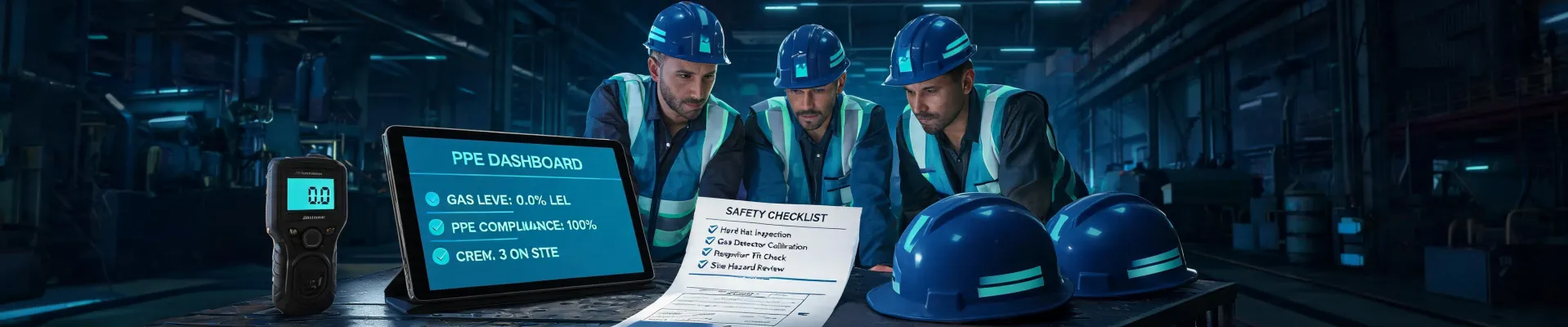
The Ask That Told Me Everything
On a Tuesday in March 2022, a fence company owner called me. He said he needed “MSA safety helmets.” That part was fine. The next sentence was the problem: “Just give me the standard one.”
I did. I sold him 48 MSA V-Gard hard hats—plain grey, low-profile, no accessory slots. They were perfect for the falling-object hazard he mentioned. He didn’t mention that his crew also welds gates and grinds steel in the same shop. A hard hat alone doesn’t protect a face from a flying chip or a UV flash. To mount a welding visor or face shield, you need a helmet with slots. I sold him one without them.
We found out when a welder used a cracked face shield because it wouldn’t mount on his “standard” helmet. That mistake cost us about $890 in expedited adapter kits and a 1-week delay. But the real cost was the safety guy’s credibility. I still keep that invoice in my desk drawer to remind myself: the order wasn’t wrong because of MSA. It was wrong because I didn’t ask about the work.
Same Mistake, Repeated With Gas Detectors and Fire Extinguishers
You’d think I would have learned. I didn’t.
In 2019, a refinery contractor asked me to quote an MSA safety gas detector. They said, “We need an MSA unit, the 4-gas one.” I recommended the MSA Altair 4XR because that’s what I had in stock and what everyone bought. They approved. Then their site safety supervisor asked, “Does it measure benzene?” No, it doesn’t. They were doing confined space work near old pipeline coatings and benzene residue. The 4XR gives you LEL, O2, H2S, and CO—all good. Benzene requires a PID sensor or a different tool. The order went from a $3,800 equipment sale to $5,600 in late-night corrections, plus a stand-down that cost more than the detector itself. That one still stings because I heard the word “refinery” and never asked the next question: “What gases are actually present?”
I made the same kind of error with fire extinguisher service. A property manager asked me who did fire extinguisher inspection near me. I gave her a name from a Web search—not a vendor I knew. The inspection company came out, tagged the unit, and said it needed recharge. Then they said, “We don’t recharge. Call this number.” She had to ask the next person, “Where to recharge fire extinguisher?” That second call took another day, the extinguisher sat out of service during a compliance audit, and the client received a written violation. The inspection fee was only $112, but the recharge cost $540 and the phone tag made her look disorganized to her board. The problem wasn’t the fire extinguisher. The problem was that I treated “inspection” as the completion of safety instead of the beginning of a maintenance loop.
Why We Keep Making This Mistake
Here’s what I’ve concluded after a decade of doing this: we buy product categories instead of hazard solutions. We search for “MSA safety equipment” because the brand is trusted. We search for “fire extinguisher inspection near me” because a deadline is looming. Then we stop searching and start ordering.
The deep issue is that safety products look like parts, but they’re actually condition-based systems. A gas detector is not a complete answer unless you know which sensors, what calibration gas, what frequency of bump testing, and what spare parts you need. A fire extinguisher isn’t a one-and-done purchase; it has monthly visual checks, annual maintenance, periodic hydro testing, and yes, recharge after use or when pressure drops. A hard hat doesn’t solve your face and hearing hazard unless you select the right accessory platform.
Here’s something vendors won’t tell you: many safety distributors are just fulfillment houses. They stock big brands like MSA because that’s what you search for. They don’t ask about your site because they assume you know exactly what you need. If the person taking your order never asks “What are your people doing on a Tuesday afternoon?” then they’re not advising you—they’re taking your money.
The legacy myth is that the brand is the protection. “MSA Safety” sounds like a force field. But MSA makes dozens of helmet styles, multiple gas detector models, and different mounting configurations. One version may be perfect for a construction site and wrong for a welding shop. That’s not an MSA weakness. It’s the reality of serious equipment. A brand earns trust by being reliable, but reliability doesn’t replace matching the tool to the exposure.
What I’d Do Differently Now
Before I quote anything from MSA or recommend a fire extinguisher company, I run three questions. You should too.
1. What is the exact job being done? If you need a hard hat, ask whether workers will weld, work near electrical lines, or need to wear ear muffs with the helmet. If you need a gas detector, ask what chemicals are on the MSDS/SDS and what the permit says. “Confined space” is not enough—confined spaces near chlorine need different sensors than confined spaces near methane.
2. What happens after the purchase? This is where I wasted $890 and $5,600. For MSA safety gas detectors, plan for calibration gas, docking stations, sensor life, and training. For head protection, plan for accessory systems like face shields, ear muffs, helmet-mounted lights. For extinguishers, plan for recharge and hydrostatic testing—not just the annual inspection.
3. What regulatory trigger started this conversation? If someone asks about fire extinguisher inspection because an auditor found a red tag, that’s a different answer than if they’re building a new shop. In one case you need speed and a company with recharge capability. In the other, you can schedule properly and maybe consolidate vendors.
If you search “fire extinguisher inspection near me,” here’s how to vet what you find: ask if they perform recharge in-house, ask if they have certified technicians, ask if they handle hydrostatic testing or outsource it. That last one isn’t always a red flag—some reputable shops send cylinders to a certified test facility. But they should be able to tell you exactly how long it takes and whether they can provide a temporary unit while yours is gone.
And if you’re buying a gas detector, don’t just type “MSA safety gas detector” and pick the first model. Call a rep and say, “We’re entering permit-required confined spaces, here is the list of potential atmospheric hazards, and here are all scheduled hot work tasks.” If the rep doesn’t follow up with questions about calibration gas and spare sensors, call someone else.
The Honest Limit of This Advice
I don’t want to sound like every business needs a full safety ecosystem. If you’re a two-person fence company that doesn’t weld, doesn’t enter ditches, and doesn’t handle combustible paint spray, you probably don’t need a multi-gas detector or a fleet of MSA helmets with every accessory. Buy a quality hard hat, keep a working ABC extinguisher, and get it inspected on schedule. That may be enough. But if you have people doing multiple jobs with multiple hazards, your purchasing process needs to be as complex as the work itself.
That’s also why I don’t recommend one “best” MSA model or one universal fire extinguisher service. There is no universal answer. There is only the answer that fits the actual hazard, the post-purchase maintenance, and the regulatory deadline that started your search.
I still make mistakes. Last month I forgot to ask whether a crew needed arc-flash protection clothing before I quoted their head kit. They caught it. I caught it. That’s why I keep the checklist updated instead of relying on memory.
Look, safety equipment is not about filling a PO box with branded boxes. It’s about having a person who assumes something will go wrong and builds a system so that when it does, the right tool is there. That’s the lesson. Not the helmet. Not the detector. The system around it.

Maeve Callahan
Maeve Callahan is a head-protection analyst covering Type I and Type II hard hats, climbing-style safety helmets, bump caps, chin straps, suspensions, liners, and face-shield carriers. She applies ANSI Z89.1, EN 397, and EN 12492 criteria while comparing impact attenuation, penetration resistance, lateral deformation, electrical class, retention strength, field of vision, mass, fit range, and temperature conditioning. Her guides help EHS teams, contractors, utilities, and buyers select helmet systems for overhead hazards, work at height, electrical exposure, accessory compatibility, and worker acceptance.