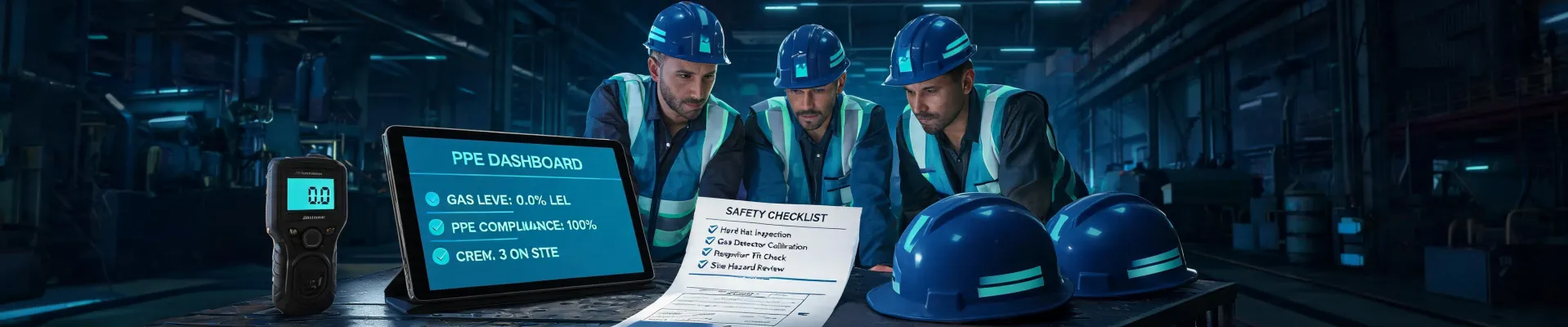
In my third year coordinating safety equipment for industrial clients, I got the call at 3:17 AM. A precision machining shop—one of our biggest accounts—had smoke detectors going off across the floor. The night supervisor had already disconnected three of them. Two were still beeping. They had a shipment leaving at 8 AM and a fire marshal inspection scheduled the same morning.
That's the kind of call I handle. Not the textbook ones. The ones where somebody has already tried everything and now it's my problem.
What They'd Already Tried (And Why Nothing Worked)
By the time I pulled into the parking lot, the supervisor had been Googling "how to stop smoke detector from beeping" for over an hour. They'd changed batteries. Vacuumed the units. Pressed the hush button. Disconnected three. The remaining two wouldn't quit.
Four hours until the truck left.
I climbed a ladder and looked at the unit. Firex smoke detector—the kind you'd find in an apartment hallway. $12 retail. Mounted in a metal shop with fine particulate dust, temperature swings, and—this is the part nobody thought about—actual smoke, from the welding stations.
The detector wasn't faulty. It was doing exactly what it was designed to do. The problem was where it lived.
The Phone Call That Saved the Day (And My Perspective)
I know a lot about safety coordination. I don't know industrial fire systems. So at 4 AM, I called MSA Safety—not the customer service line, but a project manager I'd met at a trade show years back. He picked up on the second ring. That's just how people in this industry are.
"What's your environment?" he asked.
"Metal shop. Welding. Dust. Big temp swings."
"Yeah, that unit is working exactly as designed," he said. "It just wasn't designed for that room."
He explained something that honestly should've been obvious: residential-grade smoke detectors like the Firex unit are built for standard ambient conditions—kitchens, hallways, bedrooms. Industrial spaces need different sensor technology, different housings, different UL listings. That $12 detector was doing its job—detecting what it thought was a fire hazard—and there was no cheap fix.
Then he said something I didn't expect from a guy whose company sells industrial safety systems: "This isn't our strength either. Our fire safety line is built for industrial facilities. Your client needs a commercial-grade solution, and that's a different conversation."
He didn't try to sell me anything. He told me where his expertise stopped.
The Other Problem I Almost Missed
While we waited for the morning crew, the supervisor mentioned something offhand.
"While you're here—our guys have been trying to use Milwaukee hard hat accessories on their old helmets. Nothing fits right. Visors won't lock in. Ear muffs sit crooked."
I looked at what they had. This one was actually easy. We had MSA V-Gard H1 Trivent safety helmets in our inventory back at the warehouse. The issue wasn't quality—Milwaukee makes solid gear—it was compatibility. Their accessories are engineered for their own helmet systems, not universal fits.
I got a couple of MSA Gard H1 Trivent units out to them later that day. Integrated accessory slots. Problem solved in about ten minutes. No heroics. Just matching the right parts to the right system.
What Actually Got Fixed Before 8 AM
The fire marshal's office sent an inspector at 6:30. She confirmed the residential detectors were non-compliant for that environment. They came down. Commercial-grade units went up. Signed off by 7:15.
The truck left on time.
Three Things I Took Away From That Night
1. "That's not our strength" is a green flag.
That MSA project manager could have sold me an industrial fire suppression system my client didn't need. He didn't. He told me his company's fire safety expertise lives in industrial facilities, and my client needed a commercial solution he wasn't positioned to provide. That honesty is why I call him first for everything else—head protection, gas detection, fall protection. He earned trust by knowing his limits.
2. Compatible isn't the same as universal.
The Milwaukee hard hat accessory problem was never about durability or design. It was about fit. Their accessories are excellent—on Milwaukee helmets. When a client tried to mix and match across brands, nothing locked in. The fix was boring: use systems designed to work together. Sometimes the answer is just reading the spec sheet more carefully.
3. Don't troubleshoot safety equipment at 2 AM on a forum.
The supervisor wasted three hours searching "how to stop smoke detector from beeping" when the real question was "is this the right detector for this space?" Google can tell you how to hush a residential alarm. It can't tell you that your fire safety infrastructure is using the wrong category of device entirely. That's a phone call, not a search query.
We updated our internal process after that night. Any fire system question from a client goes straight to MSA Safety—no forum research, no guessing. And when a vendor tells us something is outside their lane, we write it down. That's not a weakness. That's a map of who to call next.
The detectors working correctly the whole time. They were just in the wrong room. Kind of like how I would've been the wrong person to try to fix them without help.

Maeve Callahan
Maeve Callahan is a head-protection analyst covering Type I and Type II hard hats, climbing-style safety helmets, bump caps, chin straps, suspensions, liners, and face-shield carriers. She applies ANSI Z89.1, EN 397, and EN 12492 criteria while comparing impact attenuation, penetration resistance, lateral deformation, electrical class, retention strength, field of vision, mass, fit range, and temperature conditioning. Her guides help EHS teams, contractors, utilities, and buyers select helmet systems for overhead hazards, work at height, electrical exposure, accessory compatibility, and worker acceptance.