The $1,200 Mistake That Started With a Spreadsheet
In early 2021, I was handling PPE orders for a 140-person manufacturing plant in Ohio. I'd been doing it for about three years. I've personally made and documented maybe nine significant purchasing mistakes, totaling around $14,000 in wasted budget. (Should mention: the first one hurt the most.)
That January, our budget got cut. My manager forwarded a spreadsheet and said, 'Find cheaper hard hats.' The cheapest quote came back at about $19 per helmet. We needed 60. Total: $1,140. The next option was an MSA V-Gard safety helmet at roughly $32 each. I did the math: the cheap option saved us about $780. That felt like a win.
Here's the red flag I ignored. The supplier said the helmets were 'ANSI compliant.' I knew I should ask for the test certification and the Z89.1 label. But I thought, 'They've been around for years. What are the odds they're lying?' Well, the odds caught up with me in April.
When the Audit Asked for a Fire Extinguisher Drawing
I want to say the internal audit was in late March 2023—no, it was April 2021, I'm mixing it up with the forklift inspection. Anyway, the auditor asked for our fire extinguisher drawing. That's the floor plan showing where every extinguisher is mounted, what type it is, and the travel distance. Ours was from 2016. Two production lines had moved since then.
That was a problem. According to OSHA 29 CFR 1910.157(d)(2), portable fire extinguishers need to be readily accessible. NFPA 10 also sets maximum travel distances depending on hazard class. Our old drawing didn't just look bad—it showed extinguishers in places that no longer existed.
The auditor didn't stop there. He walked the floor and pulled three hard hats off a rack. None of them had the ANSI/ISEA Z89.1 marking. The cheap helmets had a sticker that said 'meets OSHA requirements,' which, honestly, means almost nothing without the actual standard mark. OSHA 1910.135 says head protection must meet ANSI Z89.1-2014 or equivalent. We had 60 helmets that didn't.
'Who is responsible for providing PPE?' the auditor asked. I started to say something about the workers buying their own boots. He cut me off. 'The employer. Always has been.'
He was right. According to OSHA 1910.132(d)(1), the employer must assess workplace hazards, select the right PPE, and require each affected employee to use it. OSHA 1910.132(h)(2) adds that employers must pay for PPE, with a few exceptions—like non-specialty safety shoes and boots. But the responsibility starts with us, not the person wearing the gear.
The Brunt Work Boots Search That Made It Click
A week later, one of our welders pulled me aside. He'd searched 'brunt work boots near me' on his phone, driven to a store, and bought a $170 pair of boots because the ones we issued were falling apart. He wanted reimbursement. I didn't blame him. But it forced a conversation I'd been avoiding: if we were cheaping out on hard hats, what else were we cheaping out on?
We pulled every PPE invoice from the past 18 months. Gloves, safety glasses, respirator cartridges, fall harnesses. The pattern was ugly. We'd saved maybe $4,000 on upfront unit costs. But we'd spent about $6,500 on replacements, rush shipping, and rework. That's not a budget win. That's a slow leak.
I still kick myself for not involving the workers earlier. If I'd asked three welders to try the cheap helmets for a week, they'd have told me the truth: the suspension was uncomfortable, the sweatband fell out, and the ratchet stripped. Instead, I found out when half the helmets were sitting in lockers.
The Side-by-Side That Changed My Mind
When I compared the cheap helmets and the MSA V-Gard safety helmet side by side, I finally understood why the details matter. The V-Gard had a properly marked ANSI Z89.1 Type I shell, a replaceable suspension, and a fit that people didn't hate. We ordered 12 as a trial. Within two weeks, workers were asking when the rest were coming.
We went back to the distributor and talked to MSA Safety Incorporated—the company that's been known as 'The Safety Company' for over a century. They didn't promise zero injuries. Nobody can. What they did show us was a total cost of ownership model: how a helmet that lasts three years and gets worn beats a $19 helmet that gets replaced twice a year and still fails an audit.
Bottom line: the V-Gard cost about $13 more per helmet. Over three years, the cheap option would have cost us more in replacements, lost productivity, and one very uncomfortable conversation with an auditor. That's a no-brainer when you actually run the numbers.
What We Changed (And What It Cost)
We ordered 72 MSA V-Gard safety helmets. The invoice was around $3,200—no, $3,400, I'm mixing it up with the glasses order. We also updated the fire extinguisher drawing, created a PPE approval checklist, and started a quarterly review of all safety gear.
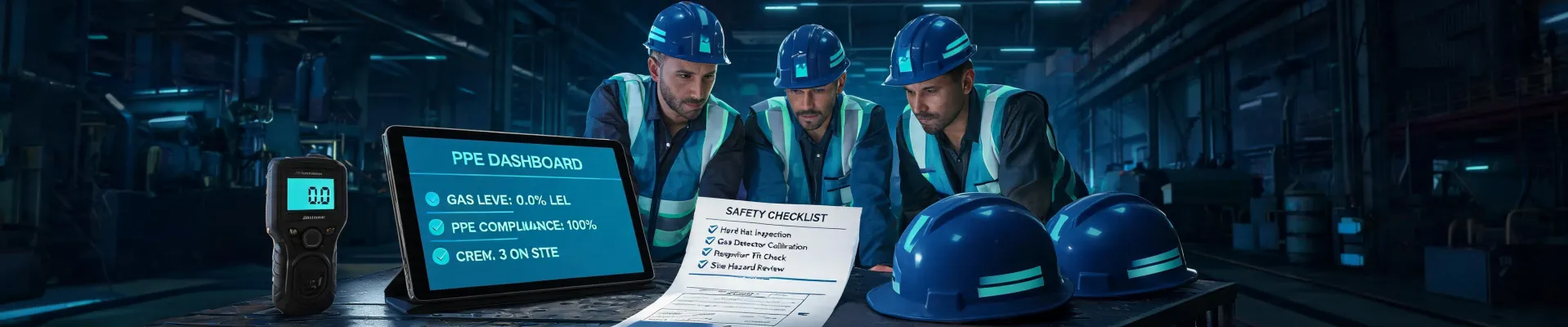
The checklist isn't fancy. It's one page. But it caught 47 potential errors in the first 18 months. Wrong sizes. Missing ANSI labels. Expired cartridges. A fall harness with a frayed lanyard that someone almost used. Each one of those could have been a bigger problem.
- Hazard assessment first. OSHA 1910.132(d)(1) requires it. We don't buy anything until we've documented the hazard.
- Verify the standard mark. ANSI Z89.1 for hard hats. Z87.1 for safety glasses. No mark, no order.
- Worker trial. If the crew won't wear it, it's a deal-breaker. Comfort is a safety feature.
- Total cost of ownership. Unit price, replacement rate, training time, disposal. The cheapest quote rarely wins after six months.
- Keep drawings current. The fire extinguisher drawing wasn't just paperwork. It was a map of who could reach what in an emergency.
There's something satisfying about finally getting the process out of my head. After the third time we ordered the wrong PPE, I created the checklist. I should have done it after the first time. But the best part is that new hires now get a 10-minute training on why we don't buy the lowest bid.
The Lesson I'd Tell My 2021 Self
The lowest quote is not the lowest cost. That's the whole lesson. I'm not saying cheap gear is always bad, and I'm not saying the most expensive option is always right. I'm saying that in safety, the hidden costs show up fast: rework, delays, audit findings, and the one thing you can't put on a spreadsheet—trust.
Who is responsible for providing PPE? The employer. OSHA is clear about that. But responsibility isn't just a legal box to check. It's the difference between handing out gear and building a system that actually protects people. For us, that meant switching to MSA Safety—or as people sometimes type it, msa-safety—standardizing on the safety helmet MSA V-Gard, and treating every PPE purchase as a three-year decision, not a one-line invoice.
If you're staring at a spreadsheet and trying to save $500, do me a favor. Ask the people who'll wear the gear. Check the standard mark. Run the total cost. And update your fire extinguisher drawing while you're at it. The cheap route cost me $3,200 and a lot of credibility. The right route cost about the same—but it's still working.

Maeve Callahan
Maeve Callahan is a head-protection analyst covering Type I and Type II hard hats, climbing-style safety helmets, bump caps, chin straps, suspensions, liners, and face-shield carriers. She applies ANSI Z89.1, EN 397, and EN 12492 criteria while comparing impact attenuation, penetration resistance, lateral deformation, electrical class, retention strength, field of vision, mass, fit range, and temperature conditioning. Her guides help EHS teams, contractors, utilities, and buyers select helmet systems for overhead hazards, work at height, electrical exposure, accessory compatibility, and worker acceptance.