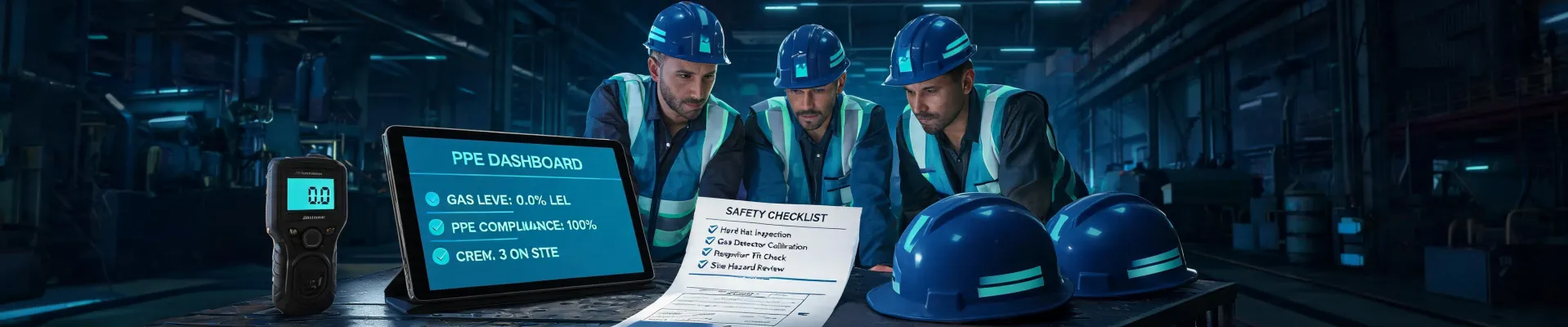
I'd rather pay for safety equipment upfront than explain an injury to somebody's family. That's not a slogan. For me, it's a line in our annual budget.
I manage procurement for a 40-person industrial maintenance company. I've handled a safety budget of around $120,000 per year for the past seven years, negotiated with more vendors than I can count, and kept a line-item record of every order in our cost-tracking system. So when I say I don't buy the cheapest safety gear available, I'm not being sentimental. I'm being calculating.
My view is simple: a small safety budget doesn't mean you should accept low-quality gear, and a small order doesn't mean you should be treated like a nuisance. In my opinion, those two things are connected.
What a $9 Hard Hat Really Costs
Early on, I bought a batch of cheap hard hats because they met ANSI Z89.1 and cost $9 each. I thought I was being smart. Put another way, I was counting the sticker price and ignoring everything else.
Within six months, those shells looked rough. Sweat and sun had faded the plastic, the suspension wasn't holding adjustment, and two had cracks around the mounting points. I replaced the whole batch. The replacement cost erased the savings.
Now we use the MSA V-Gard H1 Trivent Safety Helmet for most of the crew. It costs more, but the suspension adjusts without taking off gloves, and the ventilation makes a real difference when someone is on a roof in July. I could pretend I bought them for comfort. I actually bought them because the total cost works: one helmet that lasts under normal conditions is less expensive than two cheap ones that don't.
What Is Inside a Fire Extinguisher—and Why It Doesn't Tell the Whole Story
A few years ago, I had the maintenance-guy moment: I picked up a fire extinguisher in our warehouse and realized I couldn't tell you what is inside a fire extinguisher without checking the label. The answer for most ABC dry chemical units is monoammonium phosphate. There are also CO2, water, and wet chemical units for specific classes. The chemical choice matters, but it's not the part that usually fails.
I once saved about $90 buying a set of budget extinguishers for our job trailers. They looked the same and had the same UL mark. At the first annual inspection, one wouldn't pressurize. Another had a nozzle that clogged when I tested it. That's not a $90 mistake. That's a trust problem. Recharging and replacing cost $180, and I still had to explain to the crew why I'd bought unreliable fire safety equipment in the first place.
So now, before I buy any extinguisher, I look at the valve, the service history, and whether the supplier actually stands behind it. The inside needs to be right, but the whole unit needs to work when somebody's hand is shaking and the smoke is thick.
Gas Detectors Are the Item I Wish I'd Taken More Seriously Earlier
The conventional wisdom is that a cheap gas monitor is better than no monitor. My experience in March 2023 suggests a bad monitor can be worse than no monitor because it gives you false confidence.
One of our technicians brought a bargain personal gas monitor into a mechanical room. It read zero. The building's fixed gas detection was alarming. The cheap monitor's sensor had drifted too far to register anything. We got lucky, and lucky isn't a procurement strategy.
After that, we standardized our portable gas detection on the Bacharach MSA Safety N29-16 and kept a second unit in each truck. I'm not 100% sure we'll never have another sensor issue—that's not how sensors work—but I know the manual is clear, the calibration procedure is documented, and I'm not betting a technician's lungs on a $30 gadget from the internet.
Boots: Yes, Even Chelsea Work Boots Count as Safety Gear
Footwear is the gear people get most casual about. I used to buy generic Chelsea work boots for myself because they look decent and slip on easily. Then I noticed the soles going flat after a few months on concrete. That's not just a comfort issue. That's a fall risk.
I still wear Chelsea work boots, but now I look for a defined heel, a composite toe where the job calls for it, and a sole with actual oil-and-slip resistance. The same rule applies when I'm buying kids work boots. My teenager helps out on weekend cleanup jobs, and I ordered him a pair of proper kids work boots instead of letting him wear old sneakers. It was a small order—maybe $120 total—and honestly, I expected to be treated like a nuisance. To the distributor's credit, they spent ten minutes on the phone helping me figure out sizes. That's the experience I remember.
Small Orders, Small Budgets, and the Minimum Problem
I know what it's like to be on the small side of the table. Our early orders were embarrassing on paper: two hard hats, one monitor calibration kit, a handful of extinguisher tags. I used to apologize for them. I don't anymore.
A supplier that treats a $200 order like a nuisance is telling me how they'll treat a $20,000 order when something goes wrong. In Q2 2024, I switched one of our supply categories because a vendor refused to quote a small test order without charging an absurd setup fee. The next vendor quoted the same price and added a note: 'First order, we'll ship the extras at no charge so you can verify fit.' That note meant more to me than any volume discount.
In my opinion, 'small client' should never be a bad word. Today's small client is tomorrow's bigger client—and even if they stay small, they still deserve equipment that works.
The Bottom Line
Before you click send on a purchase order for the cheapest hard hats or extinguishers you can find, ask yourself what the total cost of ownership is. Over seven years, I've seen the pattern repeat: low first cost, higher replacement rate, more inspection failures, and a slower response when something breaks. The 'cheaper' option isn't cheaper.
I also want to be clear about my limits. I don't believe MSA Safety or any brand can guarantee zero injuries. I don't think every product with a higher price tag is automatically better. But I do believe that safety equipment is one place where you should not optimize for the lowest quote alone.
FTC guidelines say claims have to be substantiated. As a buyer, I've learned to do my own substantiating: ask for the standard, check the date stamp, and see how a supplier handles a small order. The gear that protects my crew should be chosen like it's protecting my family—because to the person wearing it, it is.

Jane Smith
I’m Jane Smith, a senior content writer with over 15 years of experience in the packaging and printing industry. I specialize in writing about the latest trends, technologies, and best practices in packaging design, sustainability, and printing techniques. My goal is to help businesses understand complex printing processes and design solutions that enhance both product packaging and brand visibility.