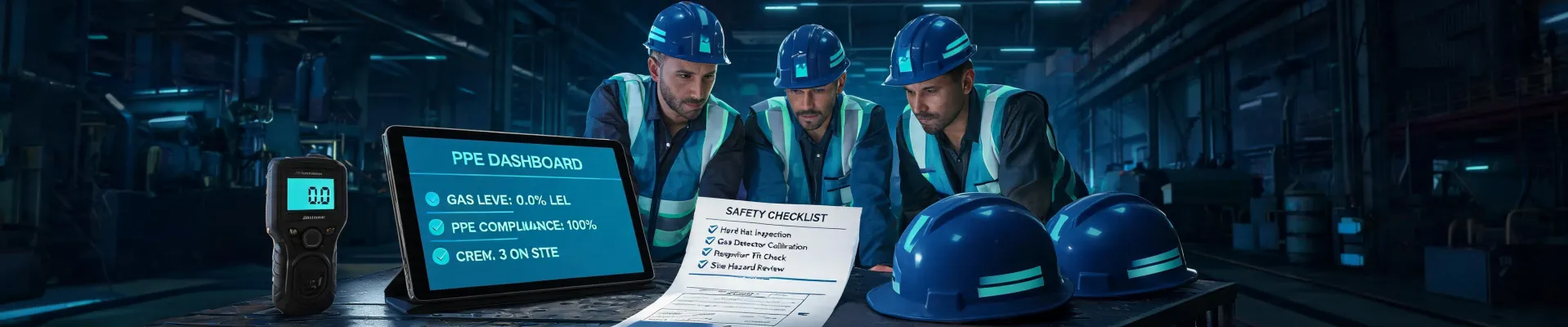
I'd rather buy one MSA V-Gard H1 than two hard hats without a clear ANSI label. That's not a brand loyalty speech. It's a spreadsheet conclusion.
I'm a procurement manager at a 240-person electrical contractor. For six years, I've managed our PPE budget, tracked every invoice, and built a cost-per-worker-per-year tracker for the gear we issue. That tracker changed how I buy hard hats.
Why I stopped buying mystery hard hats
When I audited our 2023 spending, I found we had purchased 60% more hard hats than we had workers. Nobody was stealing them. The hats were failing: cracked shells, broken ratchets, suspension straps that came apart after one summer in the sun. We replaced them like printer paper.
Then I compared total cost of ownership instead of unit price. A low-cost hat that needs replacing every eight months is more expensive than a hat that lasts three years. Actually, wait—let me rephrase that. It's more expensive in purchase orders, more expensive in labor hours, and more expensive when a foreman calls you because a shell cracked on his crew. The cheap option was never cheaper.
That's why I keep coming back to MSA Safety. Specifically, the V-Gard H1.
What the MSA V-Gard H1 actually is
The V-Gard H1 is MSA Safety's modern version of the classic V-Gard. It's a Type II, Class E hard hat with a MIPS liner—the same kind of slip-plane technology used in bicycle helmets. Type II means it's tested for lateral impacts, not just top impacts. Class E means it's tested to 20,000 volts. For my crew, that electrical rating is the whole point.
If you read MSA V-Gard H1 safety helmet reviews, you'll see the same themes: the suspension is easy to adjust, the shell feels solid, and it's comfortable enough to wear for a full shift. What doesn't show up in reviews is the cost math. I want to say our last order of H1s ran about $22 per unit, but don't quote me on that—we bundled suspension parts and pricing has changed.
Here's the simple version of hard hat classes: Class G is tested to 2,200 volts, Class E is tested to 20,000 volts, and Class C is conductive—which means zero electrical protection. OSHA 29 CFR 1910.135 requires head protection that meets ANSI Z89.1. If you hand someone a Class C hat near live gear, you aren't protecting them. Period.
The Green Devil hard hat confusion
Now, about the “green devil hard hat.” Some crews use that nickname for the green MSA V-Gard. I want to say it's been floating around job sites for decades, but don't quote me on the history. What I know is this: a real green MSA V-Gard has MSA molded into the shell and an ANSI label inside. The same goes for the V-Gard H1.
I once had a supplier try to sell me a “green devil” hard hat that was not branded, not dated, and not rated. To be fair, it was green. But I couldn't verify what it was. If someone quotes you a Green Devil, ask for the model number and the ANSI label. If they can't produce either, walk away.
The MSA fire safety connection
I also manage MSA fire safety gear—gas detectors, SCBA, and fire helmets. The logic is the same. We buy MSA because we need equipment that survives the work, not stuff that merely looks like it's doing the work. There's something satisfying about a gas detector that still calibrates cleanly after two years of being thrown in a truck bed. (Thankfully.)
Look, I'm not saying MSA is the only good manufacturer. Other companies make solid safety gear. But when I compare total cost across head protection, detection, and fire equipment, MSA keeps landing in the lowest-risk column. Lowest risk, not lowest price. For a safety budget, risk is the real expense.
Smoke detector maintenance is part of the same job
Here's the thing: none of this equipment matters if nobody maintains it. That's why the “how to reset smoke detector after changing battery” question is worth answering properly. Too many people change the battery, hear a chirp, and either live with it or disable the detector. Don't do that.
If a smoke detector still beeps after a new battery, do this:
- Press and hold the test button for 15 to 20 seconds. That drains any residual charge and resets the unit.
- Remove the battery, wait 30 seconds, reinsert it, and close the drawer completely.
- If it still chirps, clean the sensor slot with compressed air.
- If it still won't stop, check the manufacture date. NFPA 72 recommends replacing smoke alarms every ten years. A detector from 2014 is not “fine” just because it has a fresh battery.
That last point matters for hard hats too. The shell has a date stamp. MSA recommends retiring a V-Gard shell after five years from the date of manufacture—or immediately after any significant impact. Some of the old “Green Devil” hats still floating around should be in a scrap bin, not on someone's head.
I know this sounds basic. But the procurement mindset is basically: buy the right thing, write down its ID, and retire it on a schedule. Batteries, hard hats, gas detectors—all of it. It's not glamorous. It's the job.
Before you argue with me
I know what some safety managers will say: “A hard hat is a hard hat. It passes ANSI or it doesn't.” Fine. Compliance is binary. But comfort and fit are not. If a hat is uncomfortable, workers will take it off. At least, that's been my experience with electricians who spend ten hours a day in the sun. The V-Gard H1 stays on because it doesn't fight them.
I'll also admit the low-cost option has its place in truly low-risk environments. If your only hazard is the occasional dropped bolt and there's no electrical exposure, a compliant basic helmet may be fine. That said, I'd still ask why you're saving $12 on something designed to protect your brain.
My bottom line
Buy a real Class E hard hat. Make it an MSA V-Gard H1 if it fits your budget and your head. Check the date stamp. Know what the label means. And if you just changed a smoke detector battery, hold the test button until the chirp stops. That's the whole philosophy: buy the right tool, then take care of it.

Maeve Callahan
Maeve Callahan is a head-protection analyst covering Type I and Type II hard hats, climbing-style safety helmets, bump caps, chin straps, suspensions, liners, and face-shield carriers. She applies ANSI Z89.1, EN 397, and EN 12492 criteria while comparing impact attenuation, penetration resistance, lateral deformation, electrical class, retention strength, field of vision, mass, fit range, and temperature conditioning. Her guides help EHS teams, contractors, utilities, and buyers select helmet systems for overhead hazards, work at height, electrical exposure, accessory compatibility, and worker acceptance.