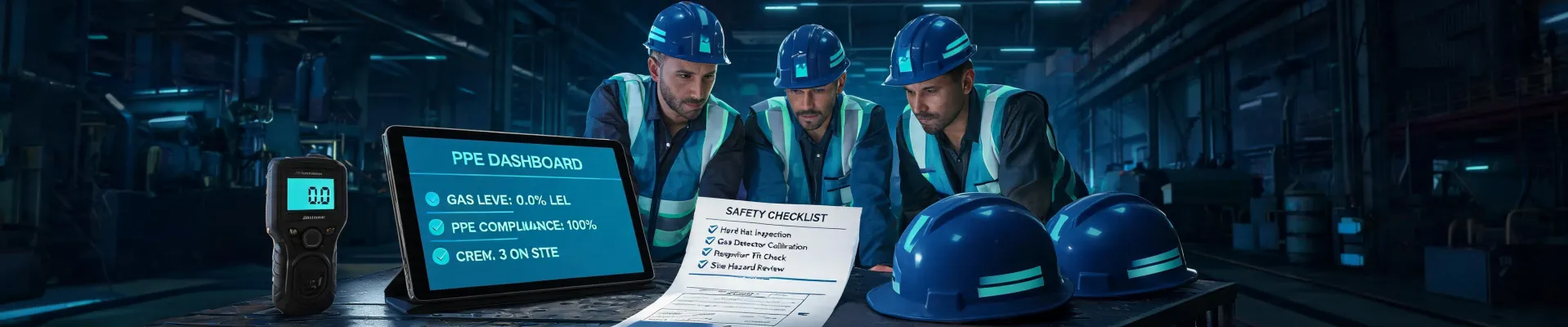
If you've ever had to rush a safety component to a site hours before a deadline, you know the feeling. You're on the phone with a safety manager whose gas detector won't calibrate or whose smoke detector won't chirp. Everyone thought the equipment was fine. It had a sticker. It passed a monthly check. Then it failed, and now it's an emergency.
I've spent the last six years coordinating emergency replacements for industrial safety equipment, and I've handled more than 200 rush orders. In my role, I'm the person people call after the 'unexpected' failure. The surprising part is how few of those failures were actually unexpected.
The Surface Problem: Equipment That Fails at the Worst Moment
When I first started in this role, I assumed emergency orders were random. A sensor died. A hard hat cracked. A boot sole split. You can't predict those, right?
Wrong. By the time I'd processed a few dozen escalated orders, I realized most 'random' failures were visible months earlier. The gas detector had been skipping its daily bump test. The hard hat had a chalky, UV-damaged shell. The smoke detector was past its 10-year service life. Nobody noticed because nobody looked past the inspection sticker.
Take smoke detectors. Ask most people how to test smoke detector, and they'll say 'press the button.' But pressing the button verifies the sounder and circuitry; it is not the same as measuring the sensor's sensitivity. A detector can pass the test-button check and still be outside its sensitivity window. That's why NFPA and manufacturers distinguish between a functional test and a sensitivity test. (Thankfully, newer detectors make this easier, but the basic confusion remains.)
According to NFPA 72 (nfpa.org), smoke alarms must be tested at least once a year, and many manufacturers recommend monthly testing. That's the floor, not the gold standard.
The Deeper Problem: Checking Is Not Testing
Here's the real issue. It's not that people don't care. It's that they confuse 'present' with 'working.' A fire extinguisher can be mounted on the wall, fully charged, and still be out of service because nobody checked the pull pin, the seal, or the pressure gauge. A fall protection harness can pass the yearly tag check while the webbing is frayed behind a label. A face shield can have the right brand name and still be missing the locking mechanism.
OSHA 29 CFR 1910.157 requires a visual inspection of portable fire extinguishers at least monthly and a maintenance check at least annually. But a quick glance at the gauge doesn't check the hose, the pin, or whether the extinguisher is actually accessible. The regulation sets a minimum; the equipment's readiness is a different question.
I see the same pattern in every category:
- Gas detection: A detector that fails bump test is an emergency. But the more common problem is that the calibration gas is expired. A partially full cylinder looks fine, but most calibration gases have a shelf life of about 12 months. Using expired gas invalidates the test.
- Head protection: Hard hats have a service life. The helmet can look fine on the outside and still be compromised by a previous impact, UV damage, or incompatible accessories. Milwaukee hard hat accessories are a good example: they're designed for specific Milwaukee helmets. A bracket from another brand might physically fit, but it can change the shell's performance and void the ANSI Z89.1 certification.
- Footwear: Durango work boots are popular, but not every pair is rated for industrial hazards. Only specific models carry ASTM F2413 ratings for impact and puncture resistance. If your job requires those protections, 'looks like a work boot' isn't enough.
In March 2024, a facility called me 36 hours before a compliance deadline. Their gas detector wouldn't calibrate, and they needed a replacement part—a Bacharach MSA Safety 07-1650, to be precise—plus an alternate monitor they could use in the meantime. We found the part, paid $210 in overnight freight, and got it there by 6:00 a.m. That's the optimistic ending.
The Real Cost: More Than a Rush Fee
Let's talk about the other ending. A different operation tried to save $80 on a replacement smoke detector, kept an old one for 'just another month,' and failed an audit because the detector didn't respond during a supervised test. The re-inspection alone cost more than twenty new smoke detectors. (Ugh.) And that doesn't count the lost time, the employee frustration, or the line that sat still while the compliance team sorted it out.
The deeper cost is trust. When a worker watches a gas detector sit in a case with an expired calibration date, they begin to assume all safety equipment is theater. Once that mindset takes hold, no logo on a hard hat brings it back.
The Solution: Test Function, Not Presence
The answer isn't to buy better equipment. It's to interact with your equipment differently. I've weighed the cost of a rush replacement against the cost of a planned spare. The planned spare always wins, and it's not close. Here's what I'd recommend:
1. Test function, not just presence
Have a concrete list of how to test each device. For smoke detectors, don't just press the test button—hold it for a few seconds, replace batteries on a schedule, and replace the entire device after 10 years or the date stamped on the unit. For gas monitors, do a functional bump test before each day's use. This is the cheapest insurance you'll buy.
2. Know that PPE has a service life
Hard hat shells, suspensions, harnesses, and extinguishers all degrade. Manufacturers like MSA Safety publish service intervals for every product they sell. MSA fire safety equipment, from SCBA cylinders to portable extinguishers, comes with inspection and replacement schedules. If those dates are missing, contact the manufacturer before you rely on the gear.
3. Keep the spare before you need it
The cost of a spare sensor, calibration gas cylinder, or complete replacement unit is tiny compared to an emergency order. I've seen a $50 part become a $500 rush because no one stocked a backup. The 'save on parts, pay for escalation' model is backwards.
Five minutes of verification beats five days of correction.
What You Can Do Tomorrow
I'm not a certified safety professional, so I can't tell you exactly what your audit demands. What I can tell you is what I see from the receiving end of hundreds of emergency orders: the facility that tests function, respects service life, and stocks spares almost never needs me on the phone at 5:00 p.m. on a Friday.
Walk around your site and ask the uncomfortable questions:
- When was this smoke detector last actually tested, not just visually checked?
- Does the calibration gas in this cabinet have a valid date?
- Are the hard hat accessories on this helmet rated for this exact shell?
- Do the work boots on this line carry the right ASTM rating?
- Is the critical spare part already in a drawer, or are we one failure away from a rush order?
Most of the failures I see were not mysteries. They were missed by people who thought they were being careful. The interesting thing is not that emergencies happen. It's how few of them are truly unpredictable.

Maeve Callahan
Maeve Callahan is a head-protection analyst covering Type I and Type II hard hats, climbing-style safety helmets, bump caps, chin straps, suspensions, liners, and face-shield carriers. She applies ANSI Z89.1, EN 397, and EN 12492 criteria while comparing impact attenuation, penetration resistance, lateral deformation, electrical class, retention strength, field of vision, mass, fit range, and temperature conditioning. Her guides help EHS teams, contractors, utilities, and buyers select helmet systems for overhead hazards, work at height, electrical exposure, accessory compatibility, and worker acceptance.