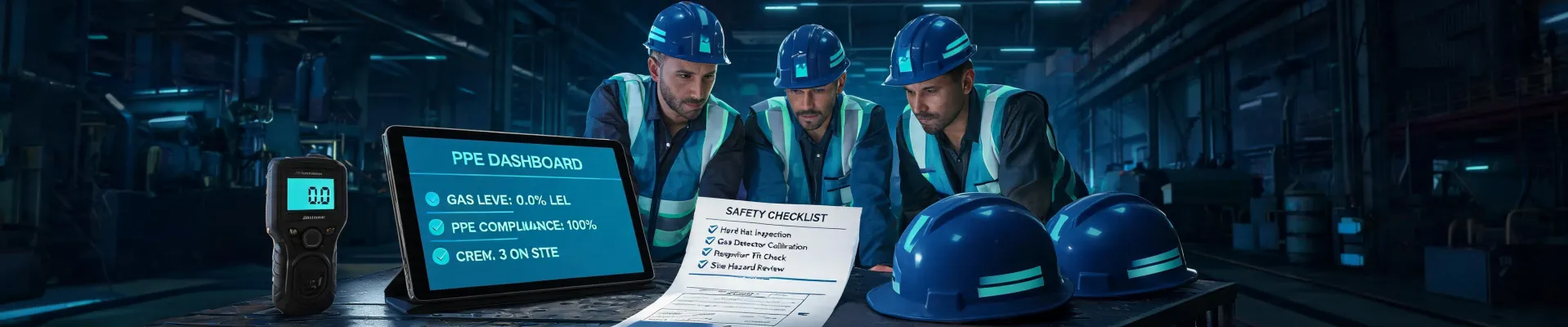
I used to think a hard hat was a hard hat. When I took over purchasing for our 400-person company in 2020, my mandate was simple—cut costs. I consolidated vendors, negotiated bulk discounts, and switched to the lowest-priced safety helmets I could find. I saved my operations manager about $12 per unit. Felt great. For about a month.
Then the complaints started. Chin straps broke. Ratchets seized up after a few weeks on site. Workers in the field started buying their own gear from hardware stores and expensing it back to the company, which completely blew up my 'cost savings.' That $12 per helmet I saved turned into a $2,000 headache in reimbursements and morale issues.
This isn't a story about how I failed (though I did). It's about how I learned that in safety procurement, the cheapest option is almost never the most cost-effective one. And it's why, after five years of managing these purchases, I've become a loyal—some might say obsessive—buyer of MSA Safety products.
The 'Penny Wise, Pound Foolish' Trap in PPE Procurement
Here's a scenario I've lived through, and I bet you have too. An employee needs a new safety helmet. The company budget is tight. You find a 'budget' hard hat for $15. The MSA V-Gard is $35. You buy the $15 one, thinking you saved $20.
But what happened next? The budget helmet didn't fit well (limited adjustment range), so the worker swapped it for their old, expired one. Or it felt flimsy, so they bought a replacement from a hardware store (now you've lost the bulk discount). Or the suspension system gave out after three months, requiring a full replacement.
Let's do the math on total cost of ownership for a crew of 50 workers over one year:
- Budget helmet ($15): Assume 60% failure rate (replacements, fit issues, worker rejection). Total cost per worker: ~$24. + $1,200 in 'reimbursement leakage' (workers buying their own). Total for crew: $2,400
- MSA V-Gard ($35): Negligible failure rate. No reimbursement leakage. Lasts full lifespan. Total for crew: $1,750
The more expensive helmet cost less in the long run. This isn't marketing—it's my actual spreadsheet from our 2023 vendor review. The $12 savings per unit evaporated as soon as I factored in replacement costs and off-policy purchasing.
What 'Quality' Actually Looks Like (A Hands-On Comparison)
I'm not an engineer. I'm an office administrator who once ordered the wrong size envelope for an entire quarter's mailings (true story—communication failure: they said 'catalog size,' I heard 'letter size'). But over the years, I've learned to spot the difference between a real safety product and a commodity that just happens to meet a standard.
When I compared a no-name hard hat to an MSA V-Gard side by side, the differences were obvious (this was back in April 2024, during our annual PPE audit):
- The shell: The cheap one felt thin and flexed easily. The V-Gard was rigid, with no decking (that flimsy movement).
- The suspension: The budget model had a basic 4-point suspension. MSA's was a 6-point Fas-Trac III system that adjusted smoothly and locked in place.
- The sweatband: The cheap one was a strip of foam. The V-Gard had a moisture-wicking, replaceable liner.
These aren't luxury features. They're functional differences that determine whether a worker will actually wear the helmet correctly all day. A helmet that sits in the truck because it's uncomfortable provides zero protection.
The 'Iron Man' Moment (Not What You Think)
One of our teams does confined space entry—inspection of manholes and sewers. I thought I was being clever by ordering a 'sewer gas detector' from a cheap supplier. It looked like a real gas detector in the catalog. Cost about $400 less than the MSA ALTAIR.
That detector false-alarmed twice per shift. The crew stopped trusting it. They'd wave it around, mutter about 'junk from corporate,' and eventually just… stopped using it. I had to expedite an MSA ALTAIR 4X from our distributor (Bacharach MSA, specifically—I remember the part number 0024-8512 because I had to re-enter it three times in our purchasing system). The rush shipping cost more than the 'savings' I'd made on the cheap detector.
The lesson: Safety gear that isn't trusted is worthless. And trust is built on reliable performance, not a low price tag.
But What About 'Iron Man' Welding Helmets?
I know the SEO says 'iron man welding helmet.' I've had workers ask me for them. They see them on social media or in movies and think they're cool. But here's the thing—a welding helmet is not a toy, and it's not a fashion accessory.
Buying a cheap 'Iron Man' style helmet (circa 2023, when I investigated this for a worker request) is a safety hazard. The auto-darkening filter might not react fast enough. The lens might not filter UV/IR properly. The shell might not protect from sparks or slag. The 'cool' factor wears off the first time you get a flash burn because the sensor was too slow.
MSA isn't known for welding helmets. But they are known for head protection. So when I need a good, reliable welding helmet, I look for one that meets ANSI Z87+ and has a proper auto-darkening filter from a reputable optical company. That 'Iron Man' helmet is a red flag. It's a Halloween costume, not PPE.
So, What Is a Fall Arrest System?
While we're on the topic of misunderstood safety gear: What is a fall arrest system, really?
A lot of people think it's just a harness and a lanyard. It's not. A proper fall arrest system is a complete chain:
- Anchorage (a structural point rated to hold 5,000 lbs per person)
- Body harness (full-body, not a construction belt)
- Connecting device (shock-absorbing lanyard or self-retracting lifeline)
- Rescue plan (what happens after a fall—suspension trauma is real)
Skipping any link in this chain makes the whole system useless. I once saw a crew using a cheap harness (the $50 kind) attached to a suitable anchor but with a simple rope lanyard—no shock absorber. If they'd fallen, the forces would have been lethal. Their 'savings' on the lanyard would have cost them everything.
MSA's fall protection line (including Miller brand) isn't cheap. Their V-Edge harness costs more than twice a generic option. But it has a padded back, quick-connect buckles that workers actually use correctly, and—most importantly—energy-absorbing lanyards that are designed and tested to save lives. That's not a feature I'm willing to cut for budget.
Counterpoint: 'But the Budget is the Budget'
I know what you're going to say. Not everyone can afford MSA gear. Budgets are tight. Price must be the primary factor.
I get it. I've been there. In fact, I agree that price matters. I'm not saying you should buy the most expensive option every time. I'm saying you should look at value, not just price.
Here's what I do now when I'm asked to cut PPE costs:
- I negotiate on volume, not on product tier. Buy a full year's worth at once and ask for a bulk discount from a partner like Bacharach MSA. The per-unit cost drops significantly.
- I buy fewer models. Standardizing on one helmet (the V-Gard) for all locations means I can buy in huge quantities and reduce inventory complexity. That saves money too.
- I push back on false savings. When finance asks why I won't buy the $15 helmet, I show them the spreadsheet. The $35 one costs me $15 less per worker. Numbers don't lie.
My view hasn't changed. The cheapest option is almost never the most cost-effective one in safety procurement. The hidden costs—replacement, downtime, lost trust, worker discomfort—consume the savings and then some. MSA Safety gear is not cheap. But it is a bargain compared to the alternatives, when you factor in what actually happens after you hand that low-cost helmet to a worker.
I didn't always believe this. I had to learn the hard way, in 2020, with that $12 savings that turned into a $2,000 problem. But now? I'm never going back. Because when safety is on the line, 'good enough' isn't good enough. And neither is the lowest price.

Maeve Callahan
Maeve Callahan is a head-protection analyst covering Type I and Type II hard hats, climbing-style safety helmets, bump caps, chin straps, suspensions, liners, and face-shield carriers. She applies ANSI Z89.1, EN 397, and EN 12492 criteria while comparing impact attenuation, penetration resistance, lateral deformation, electrical class, retention strength, field of vision, mass, fit range, and temperature conditioning. Her guides help EHS teams, contractors, utilities, and buyers select helmet systems for overhead hazards, work at height, electrical exposure, accessory compatibility, and worker acceptance.